
A Transforming World Order
An exploration of the implications for the Pacific region of the past few days of the latest Ukraine peace process.

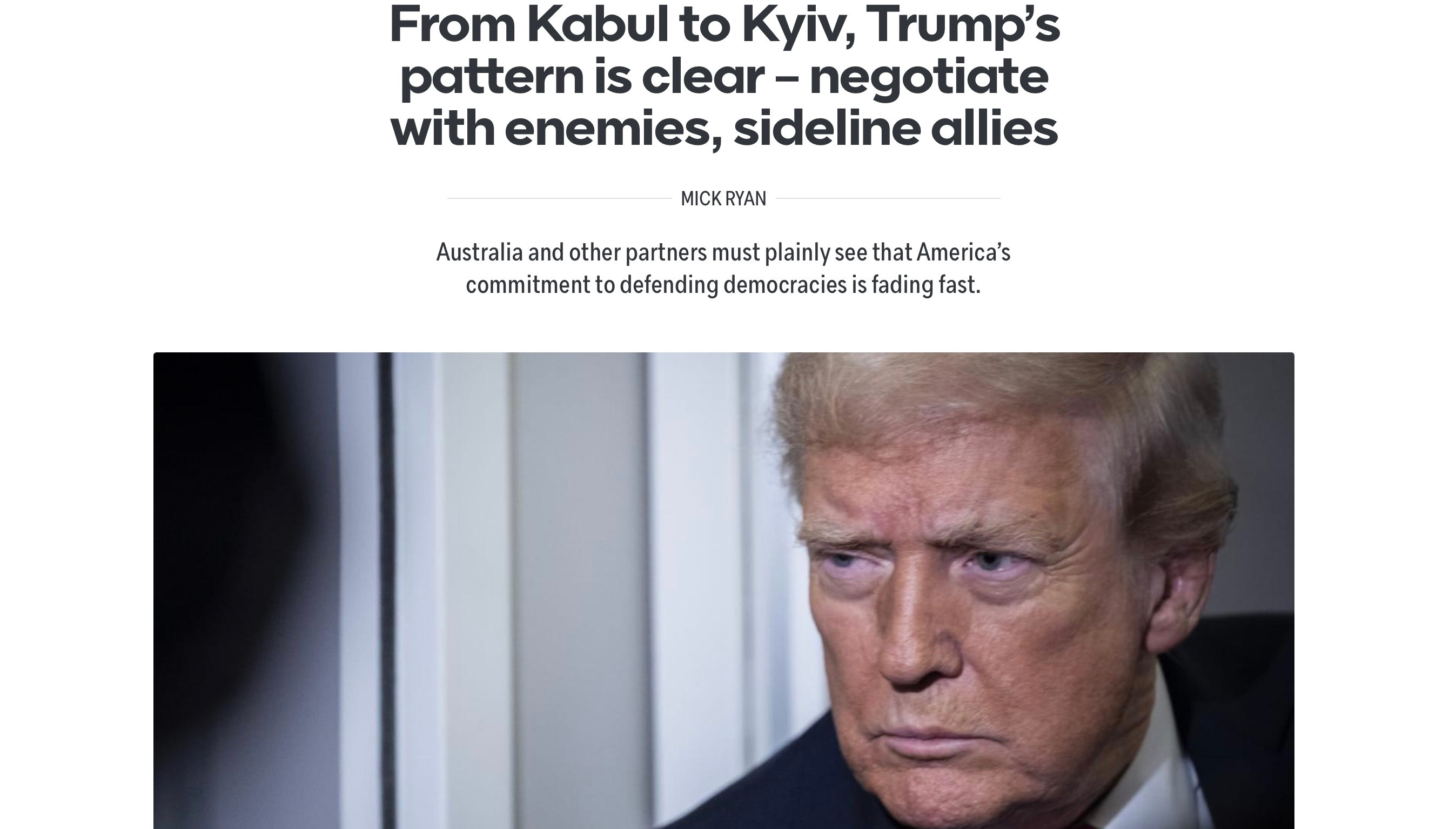
Over the past week, my team has made tremendous progress with respect to ending the War between Russia and Ukraine. President Trump, social media post, 25 November 2025.
Over the past week, the new attempt to reach a war termination agreement has played out in Moscow, Kyiv, Washington DC, Geneva and elsewhere. While the original 28-point plan basically calls for Ukraine to surrender its sovereignty and ability to defend itself, the manner in which Trump administration representatives came up with the plan and sought to impose in on Ukraine has many lessons. In my latest piece for the Lowy Interpreter, I explore the implications for the Pacific region of this past few days of the latest Ukraine peace process.
The past week’s events surrounding the new Russian-American plan to end the war in Ukraine provide an opportunity for America’s friends, allies and adversaries to reflect and learn about how much the US view of its role in the world has changed. The dedication of previous American administrations to preserving a world where the strong did not prey on the weak, and where changing borders by force was deterred by democracies with the Leader of the Free World at the forefront, is in its twilight.
During the first Trump administration, the United States conducted secret talks with the Taliban to end the Afghanistan war. The deal was negotiated without input from the Afghan government at the time. The final deal, known as the Doha Accord, had its ultimate manifestation in the humiliating, chaotic and tragic evacuation of troops and civilians in late August 2021. While blame was laid at the feet of the Biden administration, the foundations were cast by Trump.
Now, with the Russian-American 28-point peace plan for Ukraine, there is a similar demonstration of perfidious behaviour by Trump’s representatives to secretly negotiate a war termination deal with an enemy behind the backs of friends and allies. The demonstrated behaviour of Trump in two different administrations towards two different wars provides insights into how the Trump administration thinks about its relationships with foreign nations.
How might the Australian national security community apply this knowledge as Ukraine navigates its extraordinarily difficult position?
First, American allies will be disheartened by the Trump administration’s posture towards Ukraine and its willingness to absolve Russia of all its heinous behaviour. America appears to have eschewed any notion of a values-based approach to dealing with democracies and authoritarian nations, and has embraced a strategy where the best proposed deal wins regardless of its source.
All of America’s allies – including Australia – will henceforth need to retune their methods of interacting with the Trump administration and to recast their expectations of American fulfilment of alliance commitments.
Second, those nations which rely on America for their security but are not treaty allies will have much greater cause for concern than America’s allies. The obvious case study at present is Ukraine, but another nation that finds itself with a difficult predicament is Taiwan. Government officials in Taipei are surely wargaming various potential outcomes of the next few weeks in Europe, and what each outcome might mean for the future of their nation. Taiwan’s President Lai Ching-te has also sought to get ahead of the problem with a timely commitment to speed up increases in Taiwanese defence spending. Taiwanese government officials understand that America is unlikely to assist a nation in its defence if it does not help itself first. But all of America’s allies must adopt a similar approach.
For Australia, this demands a significant commitment to more defence and national security spending in the forthcoming 2026 National Defence Strategy. To not do so will provoke both more Chinese aggression against the nation and more American scepticism about a national willingness to defend Australia.
In the wake of any agreed Trump-Putin pact, Europe will continue to re-cast its security calculus and its view of the US relationship. No country in Europe seriously believes a break in the US-Europe relationship is necessary. Europe still needs America, but the relationship will evolve. The same will probably be the case in the Pacific in regards to America’s relationships with countries such as Japan, South Korea, Singapore, the Philippines and Australia.
You can read the rest of the article (for free) here at the Lowy Interpreter.
The US is no longer a trustworthy ally and will remain so for the foreseeable future. Period.
We should work towards obtaining deliverable atomic and thermonuclear weapons quietly and quickly.