

The race rarely belongs to the first mover alone. It also belongs to whichever side observes, copies, improves and fields fastest.
For some time, I have been fascinated by the idea of fast following in military affairs. While the phrase emerged from business literature in the 1980s, the idea of appropriating (stealing) the ideas, technology and organisations of a successful adversary date back to antiquity. To that end, I recently published several articles which explore this concept from different perspectives. You see links to these pieces below.
I wanted to apply this concept to the activities of my own country. As such, yesterday my short article on Fast Following, with its recommendations for the Australian Defence Force, was published by the Lowy Institute.
Advantage can sometimes go to whoever moves first but there is a complementary and often more decisive approach: fast following. This is the deliberate practice of letting an adversary absorb the cost and risk of a new idea, then copying and improving it faster than they can. The Australian Defence Force (ADF) might build a significant military edge by adopting fast following.
The concept emerged as a corrective to the idea of the “first-mover advantage”. In a 1988 article, Marvin Lieberman and David Montgomery argued that pioneers capture durable advantage through technological leadership. However, in a subsequent study of 500 brands, Peter Golder and Gerard Tellis found that first movers failed roughly 47% of the time, against just 8% for early followers.
A fast follower watches closely what works, then enters the market at speed with an improved version. Fast following works best where imitation cycles are short and copying is cheap, conditions that hold in only a few commercial sectors but which accurately describe the modern battlefield. War strips away many capital barriers and long product lives. Any advantage revealed in combat is instantly exposed to the adversary, who then has a strong motive to copy it.
As Andrew Marshall, the Pentagon’s long-time director of net assessments put it, a military that thinks through new concepts first “has a dramatic advantage until the other military establishments can emulate them or make adjustments.” In The Sources of Military Change, Theo Farrell and Terry Terriff describe this as “military emulation”.
What has changed recently is the pace of innovation and change. Imitation cycles once measured in months or years are now measured in weeks and sometimes days, driven by cheap sensors, open-source intelligence and rapid industrial production of unmanned systems.
There is a danger, of course, of fast following the wrong lesson or copying a tactic without the context that made it successful. But done cleverly, fast following compresses the cycle from observing a military innovation to learning and adapting to it. This is now a decisive variable in modern war.
Peacetime promotion systems tend to undervalue the adaptive officer who can take risks, copy good ideas quickly and improve them.
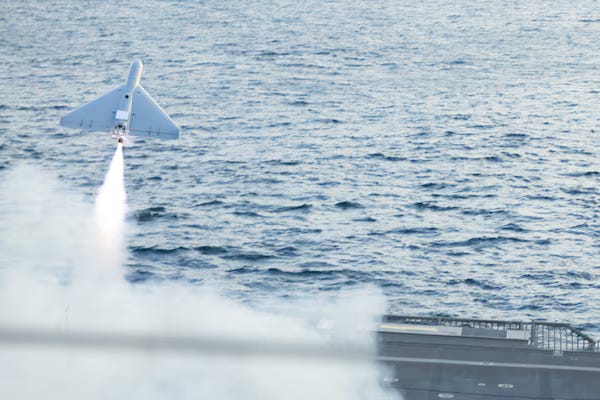
Nowhere is this more vivid than in Ukraine, where both belligerents have fast-followed each other continuously since 2022. Russia did not invent the long-range strike drone now battering Ukrainian cities nightly; it took Iran’s Shahed-136, localised production as the Geran-2, built it by the thousands, and then developed faster, jet-powered variants. Ukraine pioneered mobile air-defence teams to hunt drones; Russia copied the organisation and the tactics for its own defence. Ukraine fast-followed Russia’s unjammable fibre-optic drones, first used to devastating effect at Kursk in 2024, and within months was fielding next-generation variants with a 30km range.
At sea, Ukraine improvised the Magura and Sea Baby uncrewed surface vessels that have destroyed or disabled roughly a third of Russia’s Black Sea Fleet and driven it from Sevastopol. Russia acted as a fast follower, developing its own uncrewed vessels and accelerating counter-drone naval defences in response.
The most consequential fast following, though, has been institutional. Ukraine built the world’s first Unmanned Systems Forces branch in 2024. Russia’s Rubicon Center was established as a response to Ukrainian drone innovation and in November 2025 Moscow stood up its own Unmanned Systems Forces. Fast following has moved from copying a weapon to copying tactics to copying an entire force structure.
*******
Fast Following, Military Adaptation, and the War in Ukraine

In Clausewitzian terms, war is a contest, a complex, interactive duel between two opponents. It is a phenomenon of indeterminant length, which presents the opportunity for the contestants to adapt to their enemy’s strategy, operations and tactical approach.
*******
The lesson for Western militaries is not that invention no longer matters but that the institutional capacity to observe, copy, improve and field at speed is now equally important. If fast following is a decisive element in a larger learning and adaptation framework in modern war, the question for Australia is how to do it deliberately and systemically rather than sporadically throughout the force. Several initiatives might assist.
First, establish a dedicated intermediary that connects users, industry and procurement.Military innovation is required for the front line and with the front line. Ukraine’s current advantage is founded on an ecosystem in which front line need, private developers and rapid government procurement are tightly coupled, brokered by organisations such as Brave1. Australia needs an analogue.
Second, build a systematic capability to observe foreign wars, with systems for translating insights to the Australian context. The ADF should better study ongoing conflicts and translate their lessons into specific capability and doctrine. Context matters in this process. Every candidate innovation should include a judgement about whether, and how, it transfers to Australia’s geography, climate, force structure and potential adversaries, guarding against the error of emulating the wrong thing.
Third, preserve invention alongside fast following. The ADF must pair a fast-follow capability with protected space for exploration so that a military force can both copy others quickly and, sometimes, be the pioneer worth copying.
Finally, incentivise leaders, reform promotion and reward emulation. None of this works without leaders who value adapting fast, or following fast, over doing things the established way. Peacetime promotion systems tend to reward process discipline and undervalue the adaptive officer who can take risks, copy good ideas quickly and improve them.
Ukraine, Russia, Iran and others have spent over four years proving that in modern war, the race rarely belongs to the first mover alone. It also belongs to whichever side observes, copies, improves and fields fastest. For the Australian Defence Force, hard wiring fast following into doctrine, acquisition and leadership culture is critical.
This article was published originally by the Lowy Institute and is available here.
Recent articles on this topic:
Fast Following, Military Adaptation, and the War in Ukraine, 17 June 2026.
Fast Following, Military Adaptation, and the War in Ukraine - Part Two, 23 June 2025.
The Corsair Strikes: Fast Followers at War, 15 July 2026.
Modern War: Ukraine, the Middle East and Imperatives for Modern Military Institutions, 4 September 2026.