
China’s Lighting Operation Around Taiwan
A special assessment of China's Exercise Strait Thunder 2025A, what the People’s Liberation Army (PLA) sought to achieve and what we might learn from it.

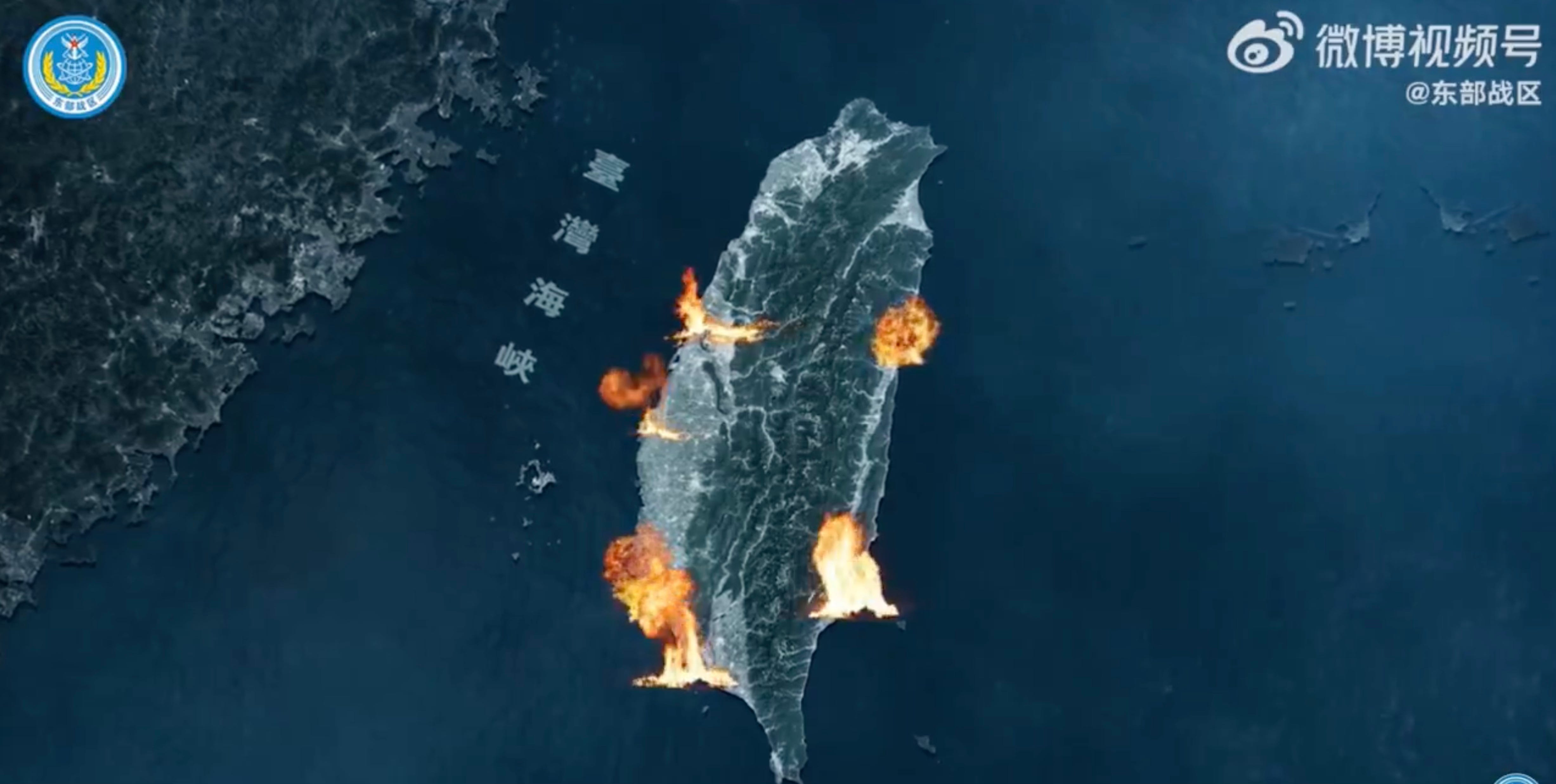
At 8pm local time on the 2nd of April, the Peoples Liberation Army Eastern Theatre Command announced the commencement of Exercise Strait Thunder 2025A. China admitted in this announcement that the exercise was a rehearsal for a blockade, and described it as "stern warning and forceful deterrence." This is the latest in an increasingly sophistocated series of large-scale joint exercises undertaken by the Eastern Theatre Command. While large-scale activities such as Strait Thunder 2025A get a lot of attention, the Chinese operations around Taiwan are constant and also include PLA Joint Combat Readiness Patrols (read more about these here).
The key activities of Strait Thunder, as described by Eastern Theatre Command, included the following:
Sea-air combat readiness patrols.
Joint seizure of comprehensive superiority.
Assault on maritime & ground targets.
Blockade on key areas & sea areas.
Exercise Strait Thunder 2025A also had a live-fire component. On 2 April, the Eastern Theatre Command made the following announcement:
According to the 'Strait Thunder-2025A' exercise plan, live- fire, long-range firepower drills were implemented in relevant areas of the East China Sea, carrying out precision strikes against simulated targets of important ports, energy facilities, and other key infrastructure, achieving the expected results.
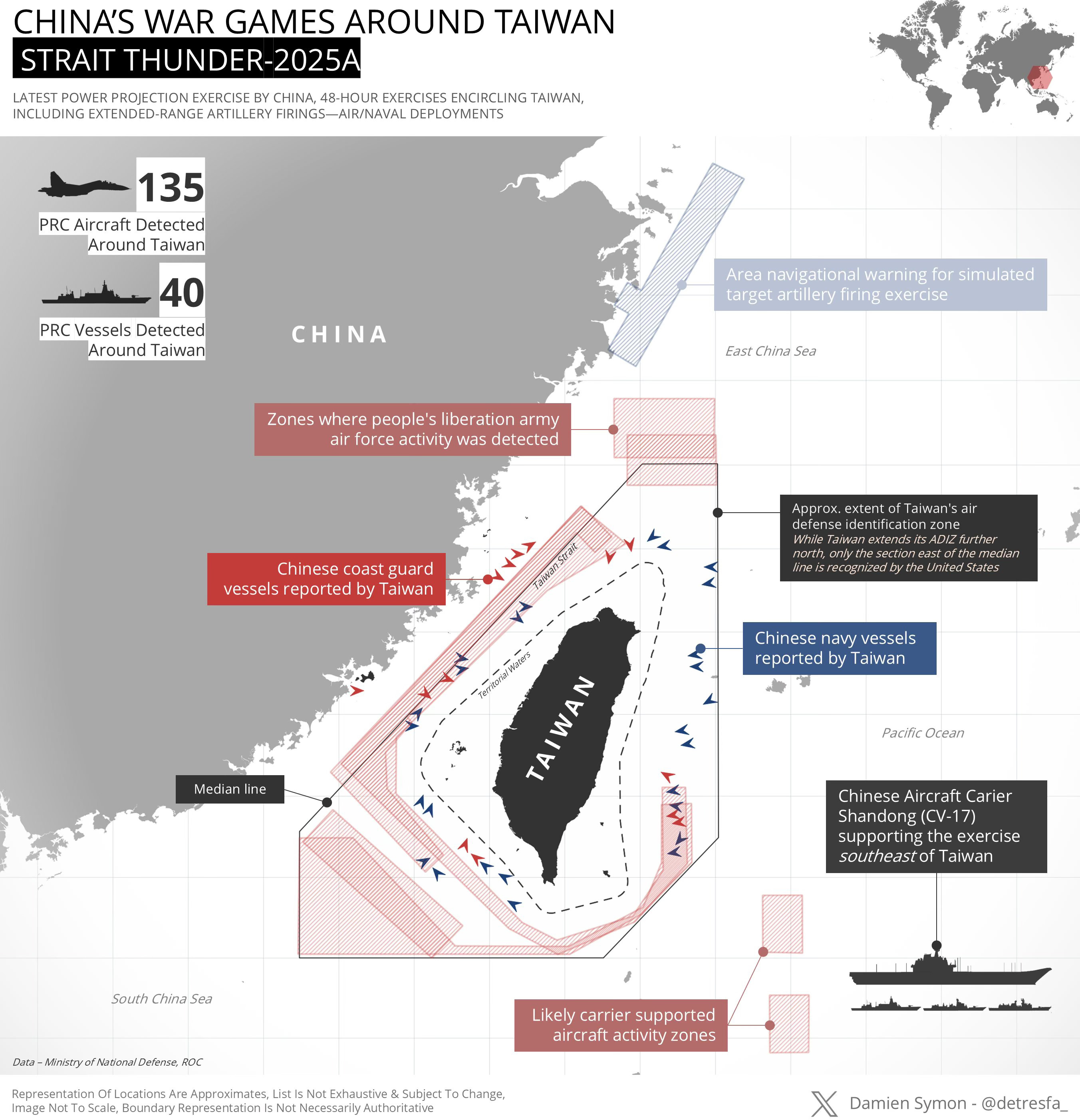
The aim of this special assessment is to explore Chinese objectives for Exercise Strait Thunder 2025A as well as what the U.S. Indo-Pacific Command, Taiwan, Japan and Australia might have learned from this two-day Chinese military exercise.
Exercise Strait Thunder 2025A Objectives
An important objective of Strait Thunder 2025A was to test the capacity of the commanders, staff, units and overall command and control of the Eastern Theatre Command. This command is one of the five joint commands established as part of a transformation of the PLA into a more integrated warfighting organisation. These commands operate under the direction of the Central Military Commission, chaired by Xi.
The Chinese theatre commands are responsible for developing and wargaming theatre-specific plans for warfighting, responding to natural disasters and military contingencies, as well as the day-to-day operations focussed on Chinese sovereignty, which includes the kind of coercive military activities conducted daily around Taiwan.
The Eastern Theatre Command has a wide variety of joint military resources to carry out its mission. Its key military formations include three PLA Ground Forces Group Armies (71st, 72nd, and 73rd) which each have around six combat brigades as well as other supporting brigades (aviation, special operations, artillery, engineers). The Eastern Theatre Command also commands the Eastern Theatre Navy, its naval aviation division, coastal defence units and two marine brigades. It also has 13 Air Force fighter and UAV brigades and regiments as well as a Bomber Division (equipped with different H6 variants), and 11 PLA Rocket Force brigades.
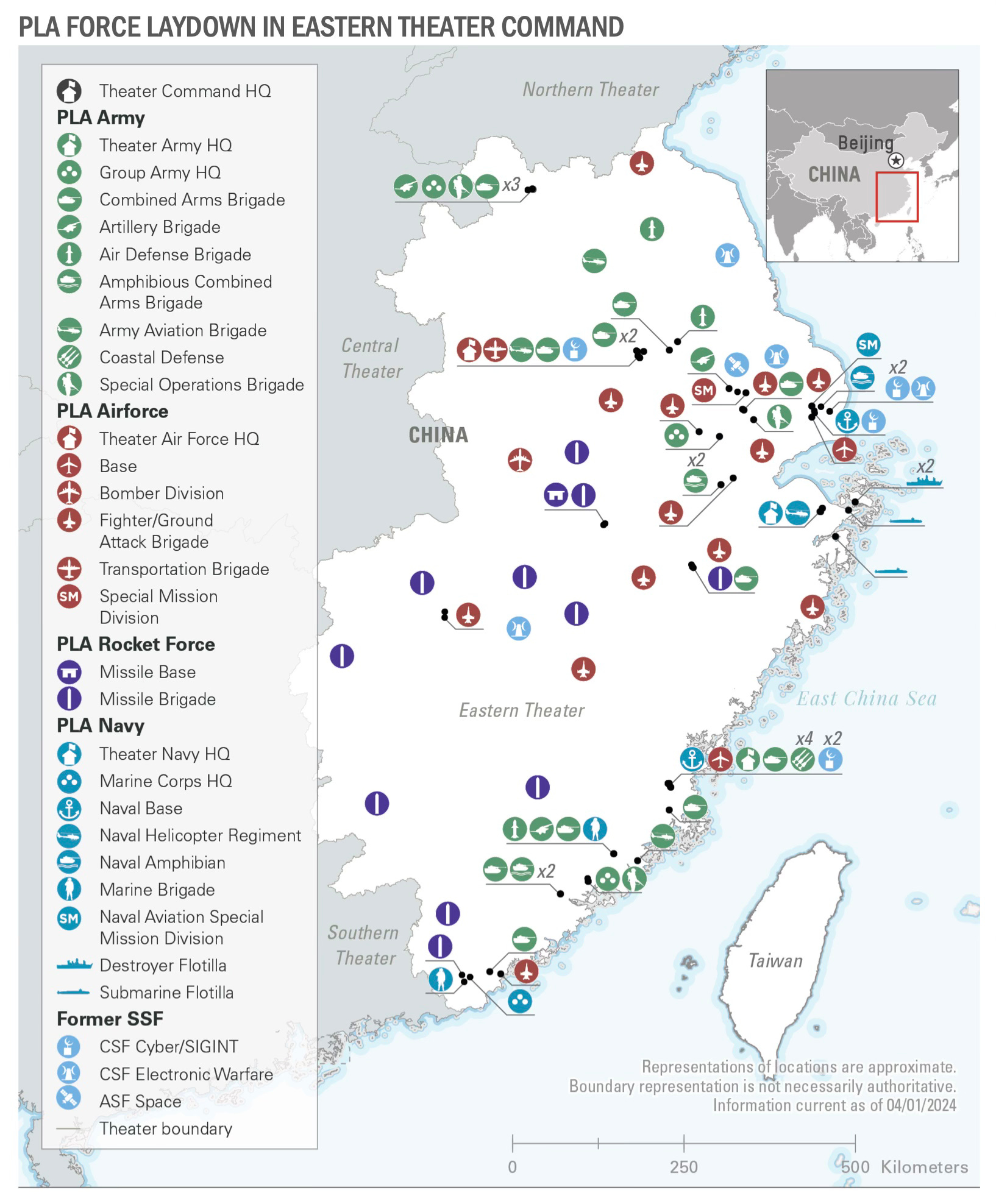
During exercises and warfighting operations, the Eastern Theatre Command is allocated elements of the PLA’s Cyberspace Force, Information Support Force and Joint Logistic Support Force as well as additional elements of the PLA Rocket Force. The primary mission of the Eastern Theatre Command is Taiwan, although it also has responsibility for Japan and contingencies in and around the Senkaku Islands. The announcement of Strait Thunder 2025A represents a continuation of this command’s increasingly larger and more complex joint exercises around Taiwan.
In conducting large joint exercises such as Strait Thunder 2025A, the PLA will have had a range of other objectives besides the development of its Eastern Theatre Command.
First, the announcement was made at 8pm local time. The timing will have been a test to ascertain the reaction of Taiwanese, Japanese and U.S. reporting and decision-making systems outside normal working hours. This might sound unusual to civilians, but in peacetime, there is a difference in the amount of people at work and immediately available between work hours during the day and overnight. By announcing this at night, the Chinese will be assessing overnight decision capabilities among the nations that might seek to oppose any Chinese invasion of Taiwan.
