
Doctorate Complete
After several years of research, writing (and editing), my PhD about the applications of historical military fiction for developing contemporary military leaders is complete.

Narrative fiction may be taken up in a variety of teaching and learning contexts to support the education of professionals working in diverse occupations. Christine Jarvis.
Some personal news today.
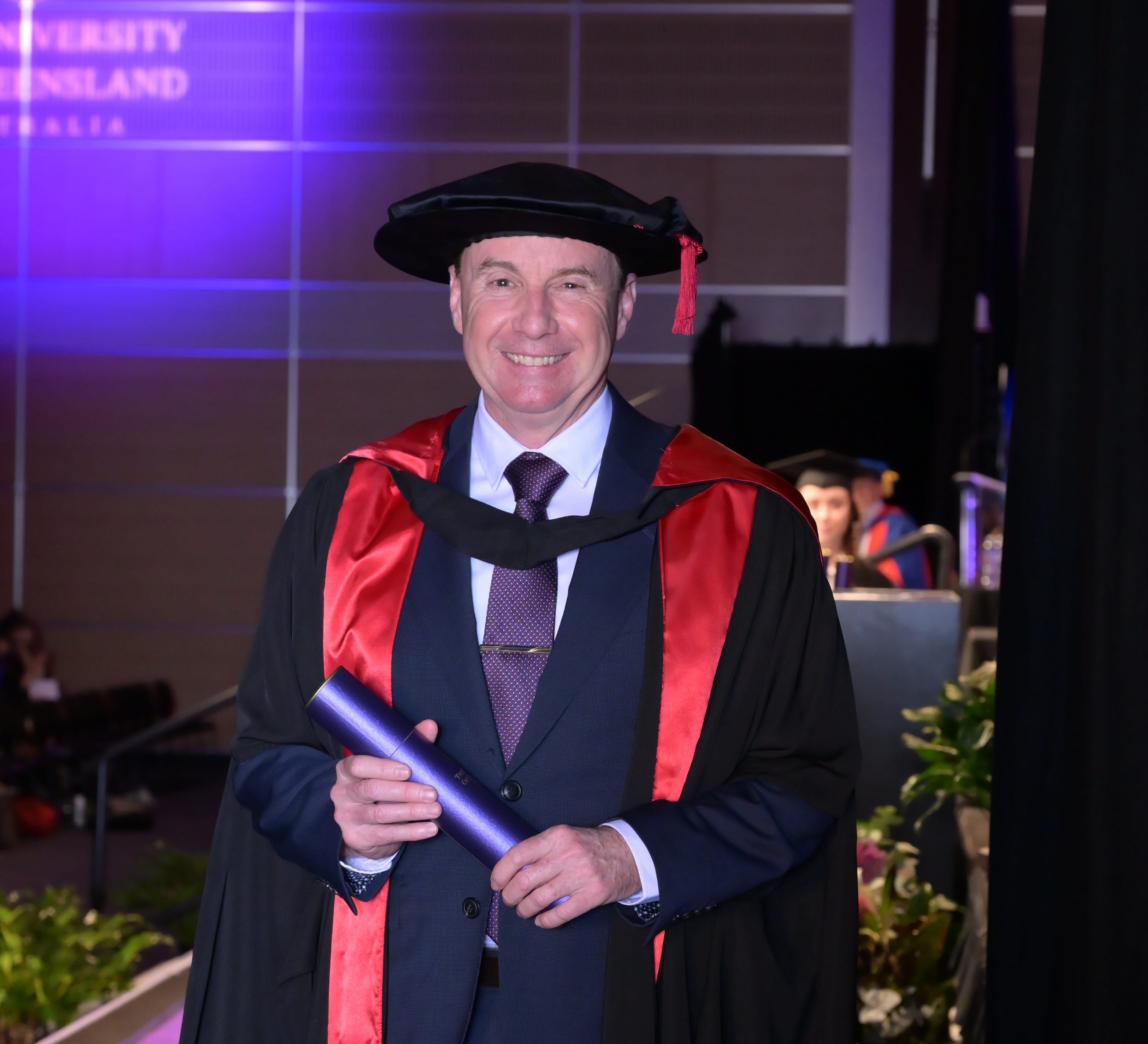
Last week I had the opportunity to walk across the stage and receive my Doctor of Philosophy from the University of Queensland. It was a wonderful conclusion to a research and writing project that I greatly enjoyed.
Thank you to my two amazing supervisors, Kim and Helen, and to my family for their support.
The title of my thesis is as follows:
Creative writing and the application of historical military stories in the intellectual preparation of military leaders.
For thousands of years, different institutions have sought for find the optimal ways of conditioning soldiers to the rigours of combat, and to ensure they can lead and be led for extended periods in traumatic circumstances. Increasingly, historical military fiction can assume some of the burden of preparing military leaders for the physically arduous, intellectually challenging and morally confronting circumstances of modern war.
While there is a place for future-oriented fiction in this intellectual development continuum, well-designed historical fiction – HISTINT – can permit a focus on the human dimensions on war to complement some of the more technologically-focused fictional narratives currently available.
The function of training and education for military personnel is to inculcate preferred behaviours and skills (especially those involving teamwork and courage) over and above other forms of behaviour (such as more individual conduct). If fiction can permit readers to enter an alternative reality of characters and worlds different from their own, such literature can expand individuals’ understanding and sympathies in a manner not always possible in real life.
Historical military fiction emerged in the late 19th century as a response to changes in the strategic threat environment in Europe as well as the rapid changes in technology being driven by the Second Industrial Revolution. This was a disruptive period of industrial transformation in the last part of the 19th century and early part of the twentieth century that has been characterised by Vaclav Smil as the greatest technical discontinuity in history.
Like the period before the First World War, which saw the publication of hundreds of novels of this genre across Europe and in the United States, the post Second World War era also saw the publication of hundreds of novels with stories about people and events of the 20th century’s world wars. And while historical military fiction has often competed for attention with the many popular military science fiction novels now available, it has remained a popular genre in the public at large. It is also a genre that now features in the recommended reading lists of many military service chiefs around the world.
Well-designed fiction, particularly military fiction, can therefore, play an important role in shifting the mindsets of individuals, and assist in their overall training and education experience in military institutions.
My project proposed that historical military fiction might provide a method to ensure that the development of humans remains at the forefront of military capability in an era of rapid and sometimes dizzying change in the development, roll out and replacement of advanced technologies. There is much to be learned about human interaction, and Clausewitz’s enduring nature of war, through stories about historic warfare.
Historical fiction, which I describe as HISTINT, can therefore complement rather than replace other forms of preparing people for the ambiguous and arduous circumstances that accompany military service.
Three key themes shape my proposal to employ historical military fiction more in the preparation of military leaders:
Uncertainty, surprise and failure: Preparing for, and operating, in the fog and friction of war. Military literature, including fiction, covers surprise, uncertainty, and failure over a two thousand year period. These concepts are ultimately human characteristics that new technologies are not going to remove. Despite the significant advances in the capacity of humans to see and understand many aspects of our world, the people who live on this planet retain endless creativity in their ability to surprise their corporate competitors, and their enemies in war.
Learning and Adaptation in Military Institutions. Technology has an important impact on war and is often a driver of adaptation. But the impetus for individual or institutional adaptation in military affairs might be something other than technology. Often, an important imperative to adapt is provided by a change in circumstances. This might be a national event, such as a country adapting its defence spending or posture due to the aggression of another nation or alliance, or an institutional occurrence, driven by the actions of a battlefield competitor. Learning and adaptation has played a crucial role in military affairs for two millennia, and historical fiction can include this as a theme to shape how military leaders think about this important topic.
Leadership and ethical decision-making in war and in military organisations. Despite the focus that technology receives in the modern era, it is people who are the foundation and heart of military institutions. Military personnel who possess the resilience to thrive in ambiguity, can exploit fleeting opportunities, and have the capacity to continuously learn have proved to be a decisive edge in historical military conflicts. Whether it is in peace or war, good leadership provides focus for getting the best performance from people. This is something that historical military fiction can immerse people in and provide important insights about leadership in adversity.
I look forward to sharing more about my project with you in due course - including the historical military fiction novel I wrote as part of it.
Congrats! A BIG deal!
Congratulations, Dr. Ryan!