
Losing in Every Dimension
An Assessment of Russia's Strategic Position in 2026, (Part 1)


Russia hit a dead-end on the battlefield, so it terrorizes Ukraine with deliberate strikes on city centres. These are abhorrent acts of terror meant to kill as many civilians as possible. Kaja Kallas, 24 May 2026.
Now that we have entered the fifth year since Putin’s launch of a full-scale invasion of Ukraine, it is becoming clear that Russia’s war is progressing very poorly. Indeed, 2026 might be the worst year so far for Putin. Therefore, I wanted to propose a thesis about Russia’s war trajectory and examine it with similar rigour to my recent ‘Turning the Corner’ article published here.
The thesis I wish to test is as follows:
Vladimir Putin is losing — not in one or two dimensions of the conflict, but in every dimension by which one might honestly measure strategic progress — military, cognitive, moral, industrial, and economic. His only viable claim to advantage at present is the disposition of the American president.
If the evidentiary case for this holds, it is an extraordinary strategic indictment of Russian strategy, Russian military capacity and Putin’s leadership. If it is even partially true, it should force an in-depth rethink of how Western governments and analysts have been narrating Russia’s position, and how they prepare for a Russia that could lose this war. And of course, it should drive further support for Ukraine and Western nations bringing still greater pressure to bear on Russia and its enablers.
On previous occasions I have used a structured framework of measures of success and failure to assess Ukraine’s war effort. These consistent measures of success and failure are useful because they set benchmarks for performance against which evidence can be gathered, and assessments made against whether success or failure is clear.
It should be noted however that there is no perfect method for assessing a war in progress. Besides the inherent uncertainties in war, systemic difficulties are present in any assessment process. In their book, Assessing War, Blanken, Rothstein and Lepore examine these difficulties in some detail, with political friction, bureaucratic friction, as well as motivational and cognitive biases being some of the biggest obstructions. That said, assessment is still vital to inform the evolution of strategy, the prioritisation of resources, the mobilisation of societal will and the maintenance of alliances.
For this assessment, I have used a method similar to my recent assessment on the trajectory of the war for Ukraine. You can read that assessment at this link. This assessment examines five dimensions — military, cognitive, moral, industrial, and economic — and measures Russia’s performance against each, before turning to the failure conditions that could still rescue Moscow’s strategic position.
Russia’s War in 2026: Measuring Strategic Failure
But nowhere, and I mean nowhere, can you find Russians talking about “victory” unless it is a person salaried directly by the Russian state, and sometimes not even all of them. Stefan Korshak, 8 June 2026
A useful foundation for the assessments in this article was my late 2025 examination of Russia’s 2025 Spring and Summer offensives, and the overall trajectory of its war effort. In that piece I concluded the following:
Russia has however demonstrated an ability to learn and improve its performance since the beginning of the war. It has evolved its higher command and control arrangements and has significantly improved their industrial support for the war. The Russians have also experimented with force structure changes and tactics.
This year offers another good case study of a Russian military institution, that despite its gains in learning, industrial production and ability to exploit the support of supporters such as China, North Korea and Iran, has failed to effectively leverage its advantages in a way that creates a decisive impact on the ground or in its aerial assaults on Ukraine.
On its current trajectory, it does not appear able to win this war.
That has profound implications for how this war should now be prosecuted and how Ukraine’s supporters might provide the assistance to allow Ukraine to achieve its strategic goals of sustaining national sovereignty, denying undue Russian influence over its politics and society and establishing a robust deterrent against future Russian aggression.
Now, what do the five dimensions of Russian power — military, cognitive, moral, industrial, and economic — look like against the context of the war in Ukraine in 2026?
Dimension 1: Military — Russia’s “meat grinder” and massed aerial attacks are consuming Russian resources for minimal return. The central premise of Putin’s military strategy since 2023 has been attritional: trade bodies and equipment for territory at a rate Ukraine and its supporters cannot sustain, while bringing Ukraine under sustained aerial attack, until Ukrainian resistance collapses or Western will fractures. That strategy requires Russia to absorb casualties at a rate it can replenish and for its aerial campaign to support battlefield gains with impacts on Ukraine’s defence industry and civilian morale. In 2026, the arithmetic of that calculation has turned against the Kremlin.
Assessment: One of the most significant military data points of early 2026 is that Russia’s current offensive operations are yielding few gains. Indeed, over the past three months, territorial gains have favoured Ukraine and not Russia (see graph below from Russia Matters). For Russian commanders, given the enormous commitment of manpower along the front line, this is a very worrying trend as they progress into the summer months. This shortfall in territorial gains, contrary to recent comments by Putin who on 5 June claimed that Russia has seized territory four times the size of Ukraine, is exacerbated by combat losses.
Now, for the first time since the invasion began, Russia is losing more troops than it is mobilising. Since the start of 2026, according to Ukrainian General Staff estimates, Russian forces lost over 160,000 personnel killed or seriously wounded. March 2026 alone produced 35,000 Russian casualties — a single-month record for the entire conflict. The Kremlin had targeted daily recruitment of between 1,100 and 1,150 personnel; the actual figure has fallen to approximately 940. For four consecutive months from December 2025, Russia’s losses have exceeded its intake.


The cost of territorial gain has also risen sharply. According to figures from Russia Matters and the Ukrainian General Staff, Russia suffered 200 casualties for each square mile taken in 2025. But, in the first five months of 2026 with a net gain of 17 square miles, it suffered over 9600 casualties for each. In the past three months, the capture of territory has moved in Ukraine’s favour.
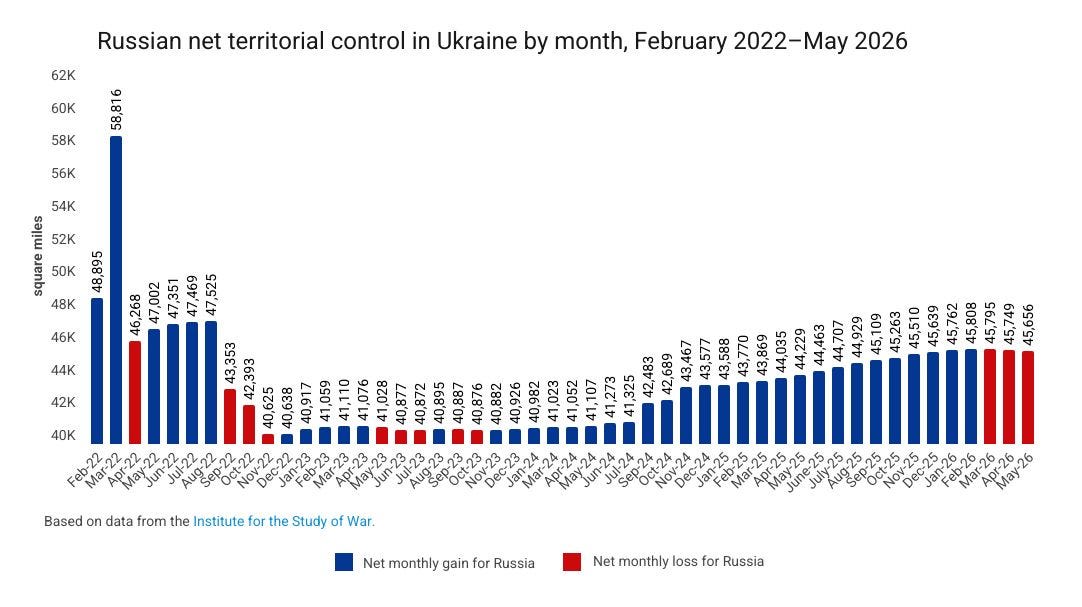
Russia’s spring offensive against the Fortress Belt opened in mid-March with large, armoured column attacks and produced catastrophic losses in its opening days, with the Institute for the Study of War assessing that the seizure of the Belt in 2026 is unlikely. Russia has been forced to redeploy elite Airborne and naval infantry units southward to respond to Ukrainian counterattacks — cannibalising its offensive timetable to plug defensive holes. Putin’s “meat grinder” is grinding through Russian men faster than Russia can produce them without much in the way of results on the battlefield.
