
Peacekeeping in Ukraine
What might governments need to think about when considering the contribution of troops to a future Ukraine peacekeeping force?

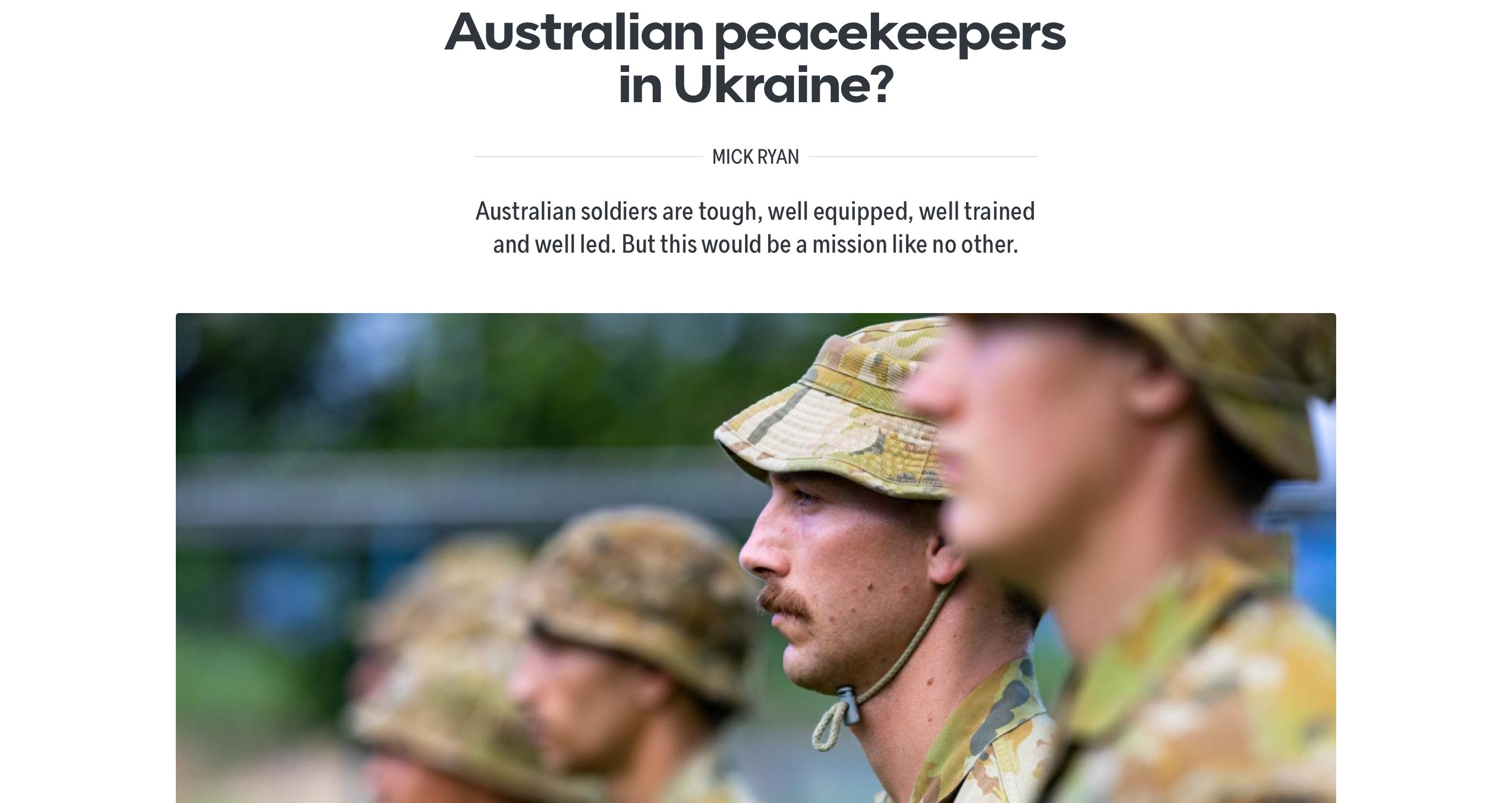
There has been discussion over the last few weeks about the potential for deploying some form of military force that would execute a peacekeeping role, or something similar, should a ceasefire be agreed in Ukraine. Apparently, a number of countries committed to providing troops at the weekend European security summit in London.
Of course, the Russians hate the idea. So, as they have throughout the war, they have stated that deploying such troops could only escalate the situation. But, pretty much everyone, except for the Trump administration, has now seen through this Russian ruse.
I have been pondering this issue for a while. But after Australian Prime Minister’s comments in the past day, where he refused to rule out the commitment of Australians to such a force, I decided so write down some thoughts. While my principal focus is the issues related to the commitment of an Australian force, I believe the political and military issues associated with such a deployment, are relevant to other nations as well.
The article below was originally published by the Lowy Institute, and is available at this link.
The past few weeks have been a maelstrom for geopolitics. The Oval Office meeting between Presidents Volodymyr Zelenskyy and Donald Trump shocked the world. However, two events in the past 48 hours may change the nature of Australia’s support for Ukraine.
First, the Trump administration has paused US military aid to Ukraine in an attempt to strong-arm Kyiv into negotiations. The real impact will be to provide Russia with an opportunity to intensify attacks for a short time, killing more Ukrainian civilians and soldiers. It also provides aid and comfort to Russia and other authoritarian regimes. Australia may have to make more aid contributions soon.
Second is Prime Minister Anthony Albanese’s refusal to rule out an Australian commitment to a future peacekeeping force in Ukraine. This shows a level of political courage because there are some in Australia who don’t see any Australian interests in Europe. But Australia has always been more than a South Pacific mini-power. As the 13th largest economy in the world, Australia has vested interest in the prosperity and security of Asia and Europe.
Notwithstanding this, there is a long way to go before any Australian soldiers (it will be the army that carries this load, as it always does in such commitments) deploy to Ukraine. Any deployment is predicated on several conditions.
First, there must be a peace to keep. A ceasefire agreed by Ukraine and Russia is the essential foundation for such a force. Second, the force will require a sound political mandate for its formation and operations, probably under the auspices of the European Union or a separate entity established for Ukraine. Third, the force will require a clear mission – what is its purpose, what are its command and control arrangements, and what are its rules of engagement? Finally, the Australian government will need to decide whether Australia’s interests are served by contributing to the force, and how much risk it can take whilst also preparing for contingencies in the Pacific.
Only once all of these questions are answered can the details of any contribution be answered. Key issues will be whether Australia sends a concentrated force or has small “penny packets” spread all over, like in Iraq. Next, what kinds of capabilities might Australia provide, and how quickly can they get there? Mechanised infantry, armour, engineers, intelligence, communications, electronic warfare, drones, logistics and good leaders will all be vital. A crucial issue will be the sustainability of the commitment. How many rotations over time could Australia provide?
Even if all of these issues are adequately addressed, there is a series of deeper challenges that the military, government and society must face. These are not restricted to Australia; every nation committing troops must ponder these issues.
The first challenge is intellectual. Australian troops would be deploying into the kind of mass, industrialised conflict which almost no living Australian has faced. But, they will also face the potential of massed use of drone and electronic warfare, an environment which is very different to other 21st century deployments by the Australian Defence Force. This will demand different organisational constructs, tactics and leadership approaches. But it will also harden and prepare our troops for 21st century conflict.
Second, there will be a profound physical challenge for the force. Nowhere will be safe. Russia has the capacity to conduct strike operations anywhere in Ukraine with drones and missiles, as well as with sabotage operations. This will demand good deception and force protection measures, that the force has integral electronic warfare, counter-drone and counter-intelligence capabilities, and that it operates under a coalition air defence umbrella. It also demands a different mindset from our soldiers.
Finally, the force which is deployed, and the society that supports it, must face up to some significant moral challenges. The government would need to accept more risk to the force than Australian governments did in Iraq and Afghanistan. Australian society must accept that casualties are possible and that the mission could involve mass casualty events, in the worst case. The government must be honest about such risks.
Finally, if such a force is deployed, it will be there to help stop the most clear-cut case of good versus evil, and of superpower moral delinquency, since the Second World War. Russia has systemically raped, tortured, murdered and looted its way through Ukraine. Our troops would be there to stop it. While the horrors inflicted on Ukrainian people will demand great resilience from peacekeepers, at the same time this gives soldiers purpose, which is the non-discretionary steel in any professional military force.
There is an alignment of Australia’s interests here, in protecting both its values and its prosperity through European security. Australia’s soldiers are tough, well equipped, well trained and well led. They would be a net positive for any European peacekeeping force and would bring back important lessons on modern warfighting for the ADF.
Just one issue remains. In the midst of an ongoing and deepening Trumpian tragedy, does Australia have the will to do this while China is stepping up its military coercion against our nation?
This article was originally published by the Lowy Institute, and is available at this link.
I am not an expert on military affairs, so I will leave the issue of the actual deployment of Australians to Ukraine to those who know best.
Where I do have an opinion, is whether Australians should be deployed to Ukraine at all. Although Ukraine is far from Australia and Asia is where our fate lies, we are still a western democracy and we should be prepared to stand up for our beliefs, even if it means going to war. So we should go if asked. I expect that many soldiers would jump at the chance to go to Ukraine as part of an Australian contingent, this what they train for.
Our deployment is predicated on the understanding that we will be going as peace keepers. I don’t see Putin agreeing to either a ceasefire or peace. So the chances of Australians deploying to Ukraine are slim.
In the meantime Australia should be upping the ante on delivery of supplies (coal?), materials and weapons (Hawkei, Eurocopter Tiger, Abrams etc)
This raises another question that Australia, Britain, the Baltics and others need to consider: what are they willing to do if there is no cease fire? Most of the arguments Ryan sets out here so well for sending troops as part of a peacekeeping force would also be arguments for sending troops before a cease fire. And there would be practical as well as moral benefits; as General Ryan points out, this is a new kind of war, with drones, and learning how to fight that kind of war is essential. Obviously the risks are far higher, as part of a force fighting a war rather than merely keeping the peace, but the odds a real cease fire seem low.