
Quick Assessment: The Big Beijing Parade
My five key takeaways in the wake of the Victory Parade in Beijing today.

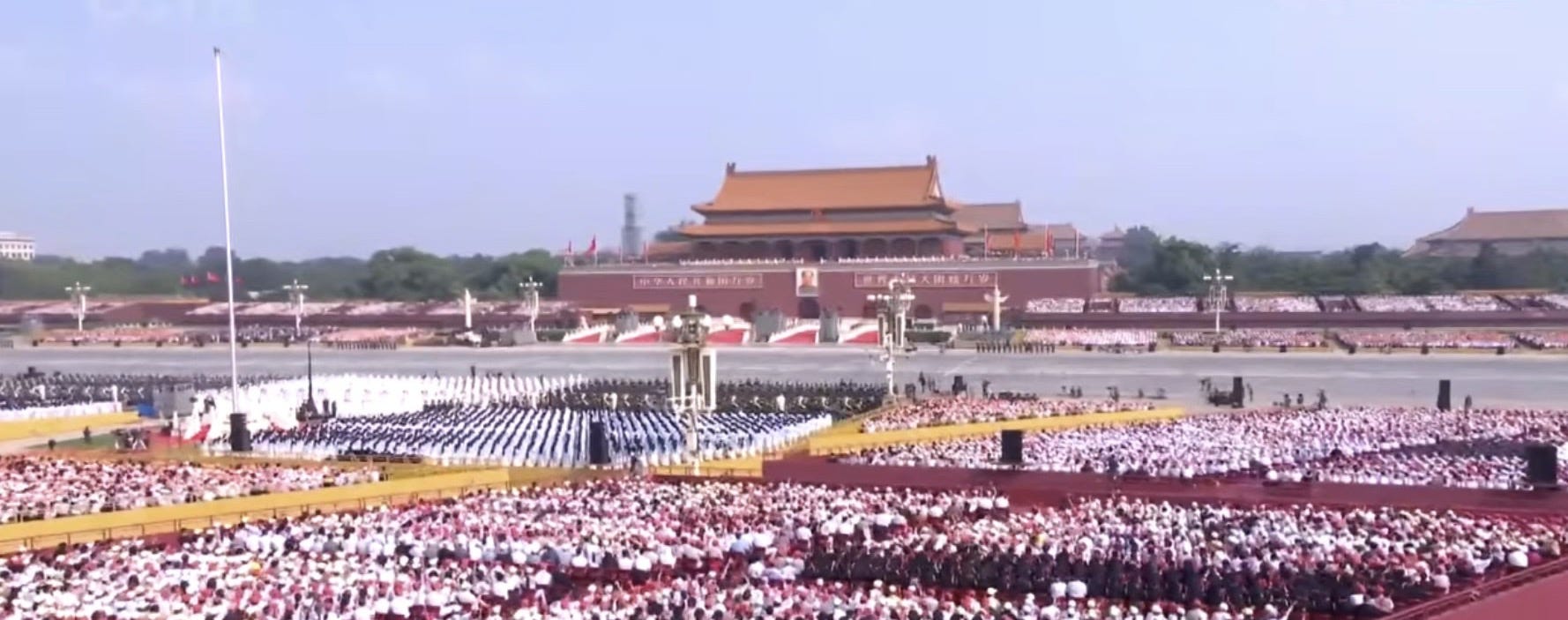
In the wake of the Beijing military parade today, I posted a quick assessment with my initial impressions of the parade on social media. For those who are not on Twitter / X, I thought I would share that assessment here.
My initial assessment of the PLA parade that has just finished in Beijing.
Overall, no major surprises although there was some new equipment. The structure and content of the parade was pretty standard. Five key themes stood out for me, however.
Theme 1. Most of the weapons and platforms were not brand new, but generally, every land, air and sea platform was more modern than that in the inventories of western military organisations. Newer does not always mean better, however. While most western military equipment has been tested in Iraq, Ukraine and elsewhere, none of China's new kit has.
Theme 2. The new weapons and platforms were interesting and demonstrate the ongoing, advanced military R&D eco-system that China now has. The Large Underwater Uncrewed Vessels, the uncrewed rotary wing aircraft and the HHQ-16C, DF-61 and DF-31BJ missiles as well as the laser defence systems were new reveals by the PLA. I thought the UAV on the back of the Infantry Fighting Vehicle was interesting.
Long gone are the days where China was reliant on Russia or other foreign systems. This level of indigenous capacity infers high levels of sustainability in any future conflict.
Theme 3. Parades are not indictors of warfighting effectiveness. Notwithstanding the impressive orchestration of the parade, and highly synchronised music and marching, these have almost zero impact on the measurement of military effectiveness. While there have been large reforms of the past decade, particularly in the creation of joint theatre commands and strategic support institutions (space, cyber, etc), we need to watch exercises and activities such as Joint Swords / Strait Thunder around Taiwan and elsewhere to gain additional insights into real PLA capability.
Theme 4. This parade was clearly designed to influence the calculus of governments in the region. While the demonstration of military power is impressive, I think it will not much shift the perspectives of regional leaders. For those who have already decided to accommodate China, the parade might reinforce why they have decided to do so. For others who have decided to resist Chinese aggression, it may provide additional purpose for doing so.
The really interesting question is this: what was Putin thinking watching the parade, and what are his generals thinking? Surely, they must be concerned. They have fought against China in the past century and have stripped out large parts of their force structure from the east to fight in Ukraine.
Theme 5. Xi's narrative remains steady and consistent. In his speech, President Xi reinforced his long-standing narrative about the inevitable rise of China. He described how “the rejuvenation of the Chinese nation is unstoppable" and that “humanity is again faced with a choice of peace or war, dialogue or confrontation, and win-win outcomes or zero-sum games.” It also gave Xi another chance to reinforce loyalty to the CCP by the PLA.
Thanks for reading this quick assessment so far. It was an interesting parade, and I am sure more will occur to me about the meaning and implications of the parade as the day goes on.
Thanks to Mick and to all of you. Putin may well find himself in a difficult situation with “allies” like China and North Korea. Which country might be the “joker” in the pack?
What a massive W⚓️ fest!
Three of the world’s worst and most hated dictators in one city - what a missed opportunity for the civilised world!
China wouldn’t last two days in a global “war”! (Thanks Xi, you W⚓️!).
And after the “war” China, Russia and North Korea would be global pariahs for the rest of time.
Good luck with your evil strategy you W⚓️’s - the whole world hates you - despite what you might think-oh, and we do NOT FEAR YOU!
Slava Ukraine 🇺🇦