
Returning to its Native Harbour: Ukraine Brings the War to Moscow (Again)
Ukraine just conducted a mass drone attack on the Russian capital, employing over 500 drones to penetrate 3 of the 4 air defence rings around Moscow. What does this mean for the war's trajectory?

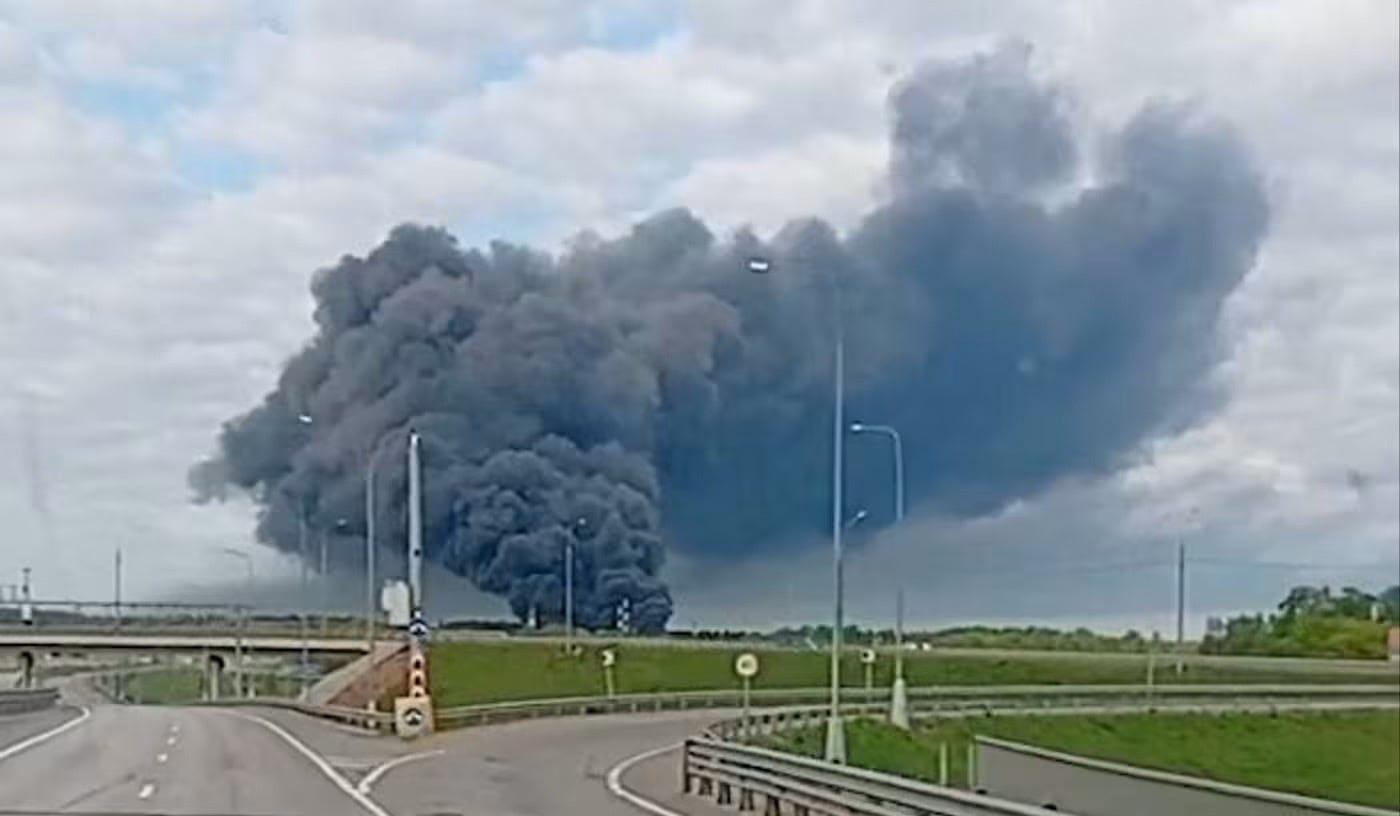
The war is quite predictably returning to its “native harbor,” and this is a clear signal that one should not pick a fight with Ukraine or wage an unjust war of conquest against another people. President Zelenskyy, 18 May 2026.
In the early hours of 17 May 2026, Moscow residents woke to the sound of explosions. Ukraine launched what Russian officials described as the largest drone assault on the Russian capital in more than a year, sending more than 500 unmanned systems deep into Russian territory and striking targets within the city and across the surrounding region. At least four people were killed and a dozen injured. Fires broke out near the Moscow Oil Refinery in the Kapotnya district. The Angstrom microelectronics plant in Zelenograd, a key node in Russia’s defence industrial network, was struck. Debris fell on the grounds of Sheremetyevo Airport, Russia’s busiest aviation hub. Russian air defences claimed to have intercepted 556 drones overnight across the country, and more than 120 over the Moscow region alone. Some, as the burning refinery and the smoking ruins of residential buildings showed, got through.
This was not the first attack on Moscow, and it was not designed as purely a propaganda spectacular. The Moscow attack was the logical continuation of a Ukrainian long-range strike campaign that has been building for four years, and which is now reshaping the strategic landscape of the war in ways that Vladimir Putin cannot easily reverse.
Target Moscow: A Campaign Built Over Four Years
While Ukraine’s drone campaign against Russia has been ongoing for four years, the campaign against Moscow has a clear genealogy. It began in May 2023, when two drones exploded above the Senate Palace inside the Kremlin. This shocked the Russian public and signalled that the war that Putin started in Ukraine could reach the Russian seat of power. By July 2023, strikes had begun reaching Moscow’s commercial and financial districts. Through 2024, the campaign broadened, with attacks increasingly focusing on the infrastructure underpinning Russia’s military economy, including fuel depots and oil refineries. A major strike in March 2025 saw more than 70 drones intercepted near the capital in a single day, at that stage the largest attack of the war.
By early 2026, the cadence and scale had intensified further. Between March 14 and 16 this year, approximately 250 drones targeted the Moscow region over three consecutive days. The strikes were not just symbolic. They were operational, targeting military-industrial facilities, fuel infrastructure, and the Russian air defence system. The May 17 attack was the culmination of this progression, not an outlier.
Zelenskyy’s Signal
Those watching Ukraine’s political messaging were not surprised. On 15 May 2026, two days before the Moscow attack, President Volodymyr Zelenskyy stated publicly that he had met with the leadership of the General Staff, military intelligence, and the Security Service to discuss expanding long-range strike operations. He was explicit that Ukraine’s campaign against Russian oil infrastructure, military production, and logistics networks would intensify. He described these operations as Ukraine’s own form of “long-range sanctions” against Russia.
In his social media post, Zelenskyy stated that:
We are defining targets for our next long-range sanctions against Russia over this war and the strikes against our cities and villages. Ukraine will not allow any of the aggressor’s strikes that take the lives of our people to go unpunished. We are entirely justified in our responses against Russia’s oil industry, military production, and those directly responsible for committing war crimes against Ukraine and Ukrainians. I am grateful to our warriors for their dedication to defending Ukraine’s interests, and to all involved Ukrainian institutions for building a truly strong system of our long-range sanctions. This is having a tangible impact.
Russia had just delivered one of its most devastating strikes of the war. Between 13 and 14 May, Russian forces launched 1,567 drones and 56 missiles against Ukraine, killing at least 24 people in Kyiv, including three children, when a missile destroyed a nine-storey apartment building. Zelenskyy, standing at the ruins, told the world that Ukraine would respond.
