
Selective Belligerence and Unconditional Surrender
What the Iran War May Be Telling President Xi in Beijing and Putin in Moscow

There is a phrase that has circulated in American military organisations for a long time, which I became acquainted with during my time at the Marine Corps Command and Staff College over two decades ago: you want it bad, you get it bad. It is a phrase that speaks to the danger of letting short-term emotion or political convenience override strategic clarity.
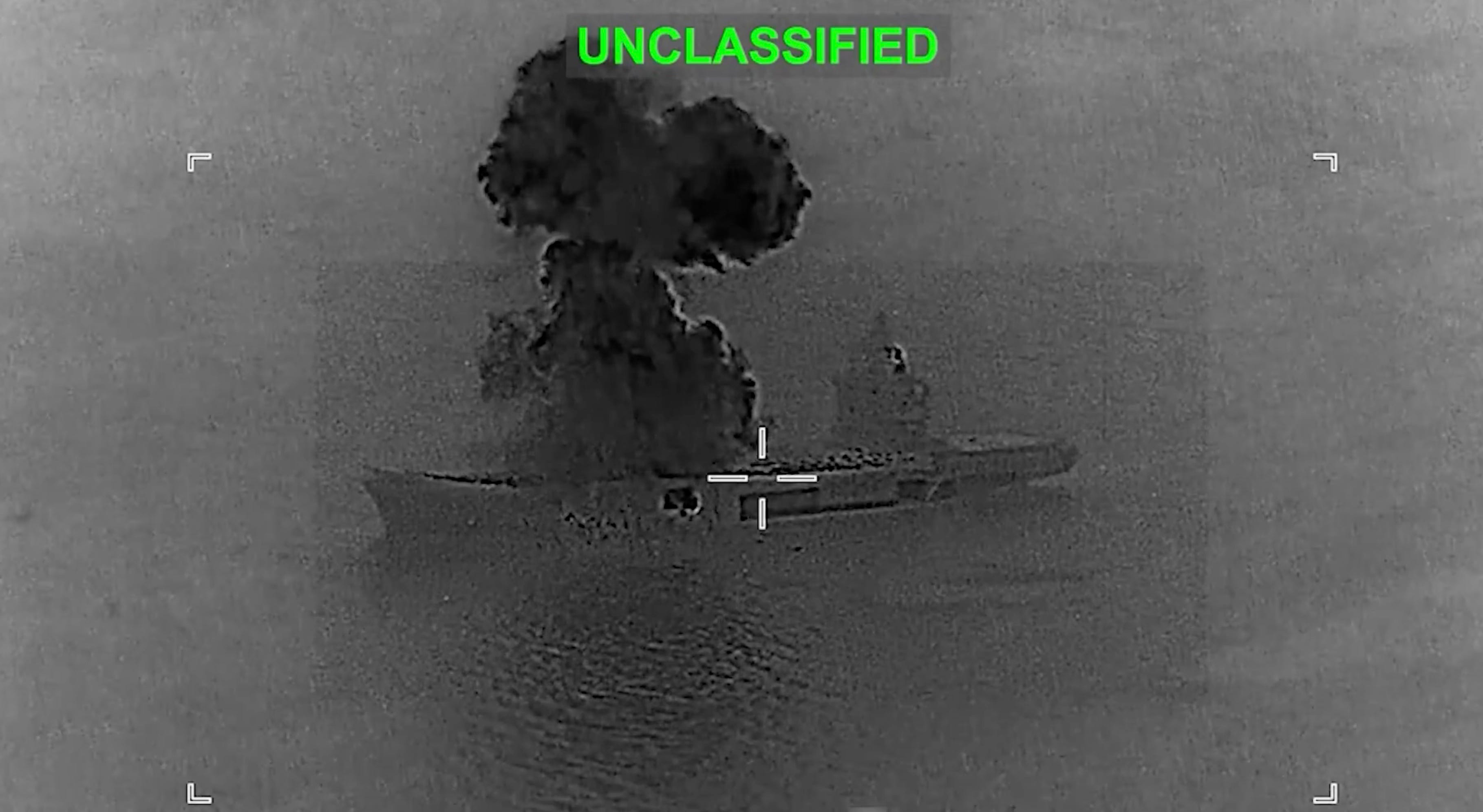
As the United States and Israel begin their second week of military operations in Operation Epic Fury, it is worth pausing the tactical scorecard — the destroyed missile launchers, intercepted missiles and drones, the sunken Iranian naval vessels, and the growing reduction in Iran’s drone and missile attacks — and asking a tough question. What signal is this war, and the political decision-making surrounding it, sending to the leaders of the authoritarian regimes – China and Russia - that truly matter?
The answer, as I argue in this article, is a troubling one.
A Rhetoric of Power is Not Strategy
Since the start of the war, the White House has been posting short videos that are meant to portray American strength. One, which appeared on Friday and was called Justice The American Way, is a compilation of movie clips that features Transformers, a drug kingpin, Braveheart, Deadpool, Sith Lord Kylo Ren, Tony Stark, Master Chief from Halo, and Maverick. Another showed a computer game character with the subtitle “Ah shit, here we go again.”
Putting aside the weird nature of the videos, it was an attempt to not just win the war against Iran but win the story of the war at home and abroad. But narratives are not strategy.
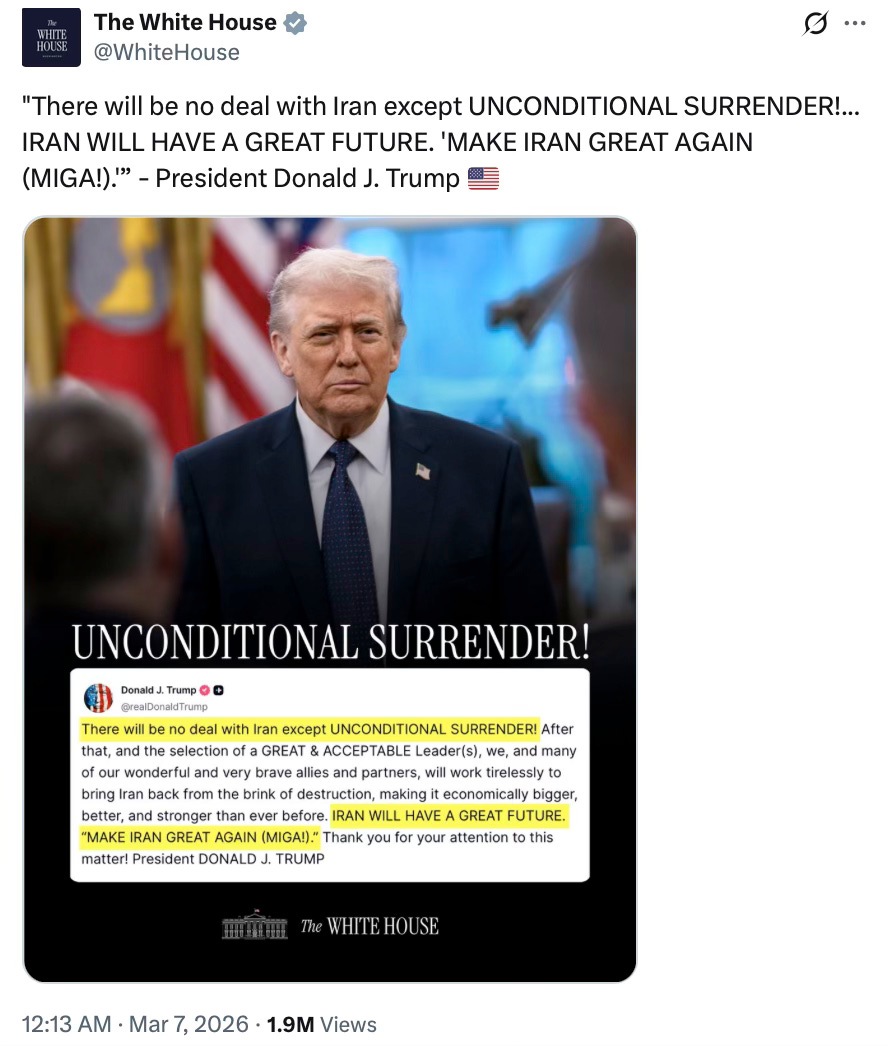
On Friday, President Trump posted the following declaration on social media:
There will be no deal with Iran except UNCONDITIONAL SURRENDER!
The demand, framed in the language of the Second World War Two allies after the 1943 Casablanca Conference, is being applied to a nation of 90 million people whose foreign minister was already declaring his forces ready for a potential ground invasion. The term “unconditional surrender” was later clarified by the White House press secretary as meaning that Iran “can no longer pose a threat to the U.S. and our troops in the Middle East.” This is a slightly different meaning to the 1943 definition, and frankly, means that it is a term so broad here as to be meaningless.
That is a problem.
It is an obvious domestic issue for Trump because it further confuses the aims of this operation and obfuscates the situation for those who are paying for its execution: the American taxpayer. In a geopolitical sense, it is a major problem because it provides further evidence, after Venezuela, Caribbean counter-drug operations and the Greenland debacle, that the Trump administration has little interest in confronting the most vicious and powerful authoritarian powers: China and Russia.
It is the foreign policy equivalent of an old metaphor: the three toughest guys in a bar get in a fight where they punch everyone in the bar except each other. The optics are not lost on allies, nor on two of the world’s most attentive strategic observers: Putin and Xi.
The Russia Sanction Paradox
Even as American and Israeli jets continue their demolition of Iranian military forces, missile factories and command bunkers, Treasury Secretary Scott Bessent announced a temporary 30-day waiver allowing Indian refiners to purchase sanctioned Russian oil. “To ease the temporary gap of oil around the world,” Bessent said, the administration was authorising transactions involving Russian crude already stranded at sea. He then went further, suggesting the US “may unsanction other Russian oil” entirely.
This move, a result of oil prices smashing through $90 per barrel, carries a strategic cost with impacts beyond global energy markets. In October 2025, the Trump administration took a significant step — sanctioning Rosneft and Lukoil, Russia’s two largest oil exporters —to pressure Putin to negotiate and agree to a ceasefire in Ukraine. That American signal of resolve has now been diluted. Unfortunately, this was not achieved by Russian diplomatic concessions, but by America’s discomfort with the consequences the war it started elsewhere. And, the Carnegie Endowment has noted that with Iranian and Venezuelan oil supplies disrupted, Russia emerges as the primary beneficiary, now better positioned to meet China’s energy needs.
Concurrently, Russia now appears to be providing the Iranians with targeting intelligence. This includes satellite imagery of American warships and aircraft, the locations of US early warning radars and command nodes. But the Trump administration’s response to Russia’s quiet belligerence is to ease its economic pressure on Moscow.
Interestingly, Trump’s statements about Iran’s future and the Iranian people have been conspicuously absent in his rhetoric about Ukraine. In his most recent post about Iran, Trump described how:
We, and many of our wonderful and very brave allies and partners, will work tirelessly to bring Iran back from the brink of destruction, making it economically bigger, better, and stronger than ever before. IRAN WILL HAVE A GREAT FUTURE. “MAKE IRAN GREAT AGAIN (MIGA!)
At no time during his second administration has Trump shown the same kind of empathy for the people of Ukraine. Instead, Trump has focused on criticising Ukraine’s President Zelenskyy while ensuring only the most minimalistic criticism is directed at Putin.
What Beijing and Moscow Are Learning
Strategy is ultimately about the relationship between political will and military means. The adversary’s task is to assess not just your capability, but your willingness to absorb cost and sustain commitment against them. China and Russia are watching the new Iran War with great political and professional interest, and they are drawing conclusions that should concern every Western strategist.
