

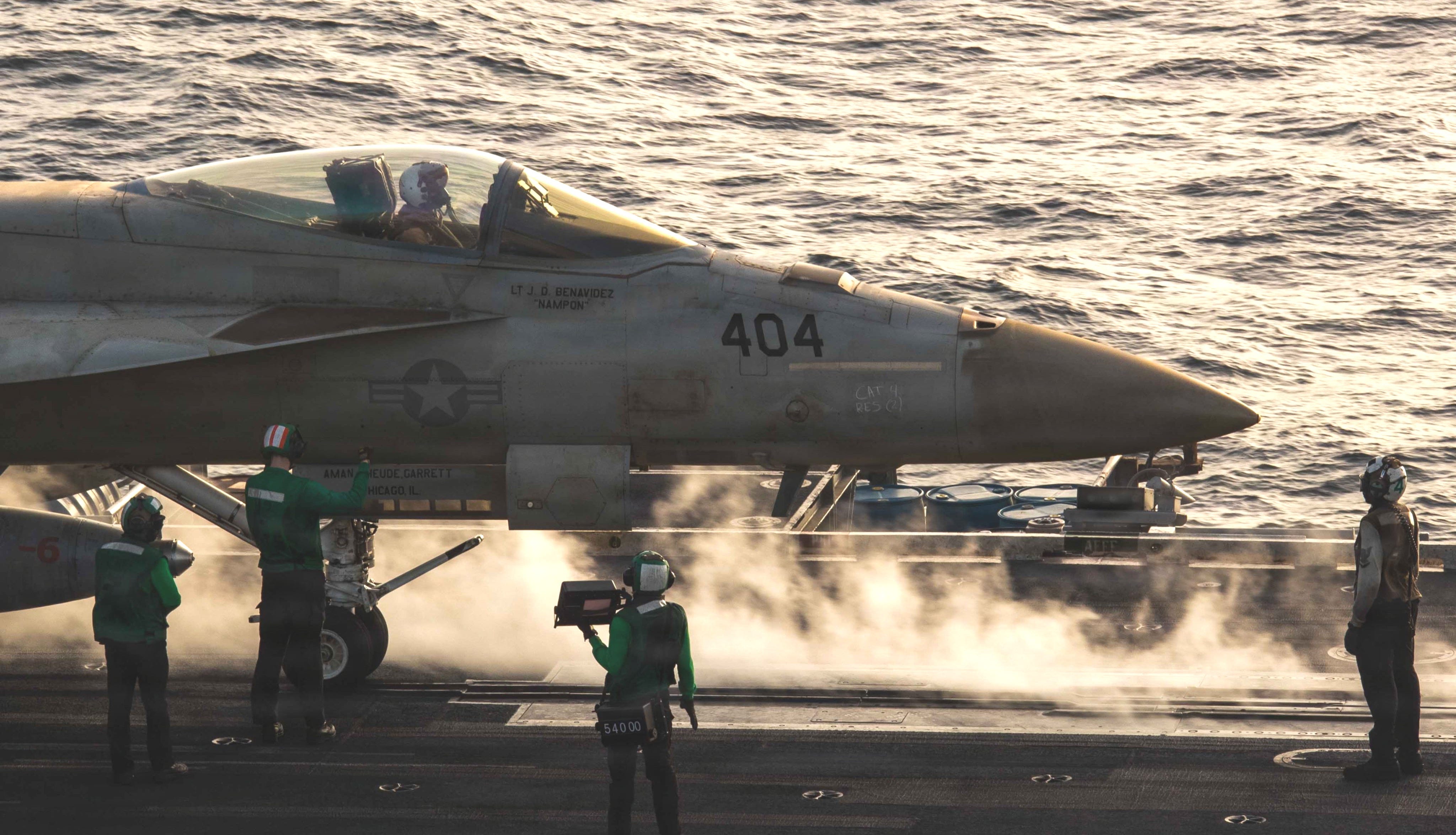
WE GOT HIM! President Trump, 5 April 2026.
[Update] A U.S. Air Force weapons officer whose F-15E had been shot down over Iran was rescued by U.S. Special Operations forces in a night mission that saw U.S. military forces operating deep inside Iran.
In the last few hours, the American president issued yet another social media ultimatum to the Iranian regime. How, and if, he follows through on this threat to “unleash hell” on Iran if it does not open the Strait of Hormuz in 48 hours will be interesting to watch.
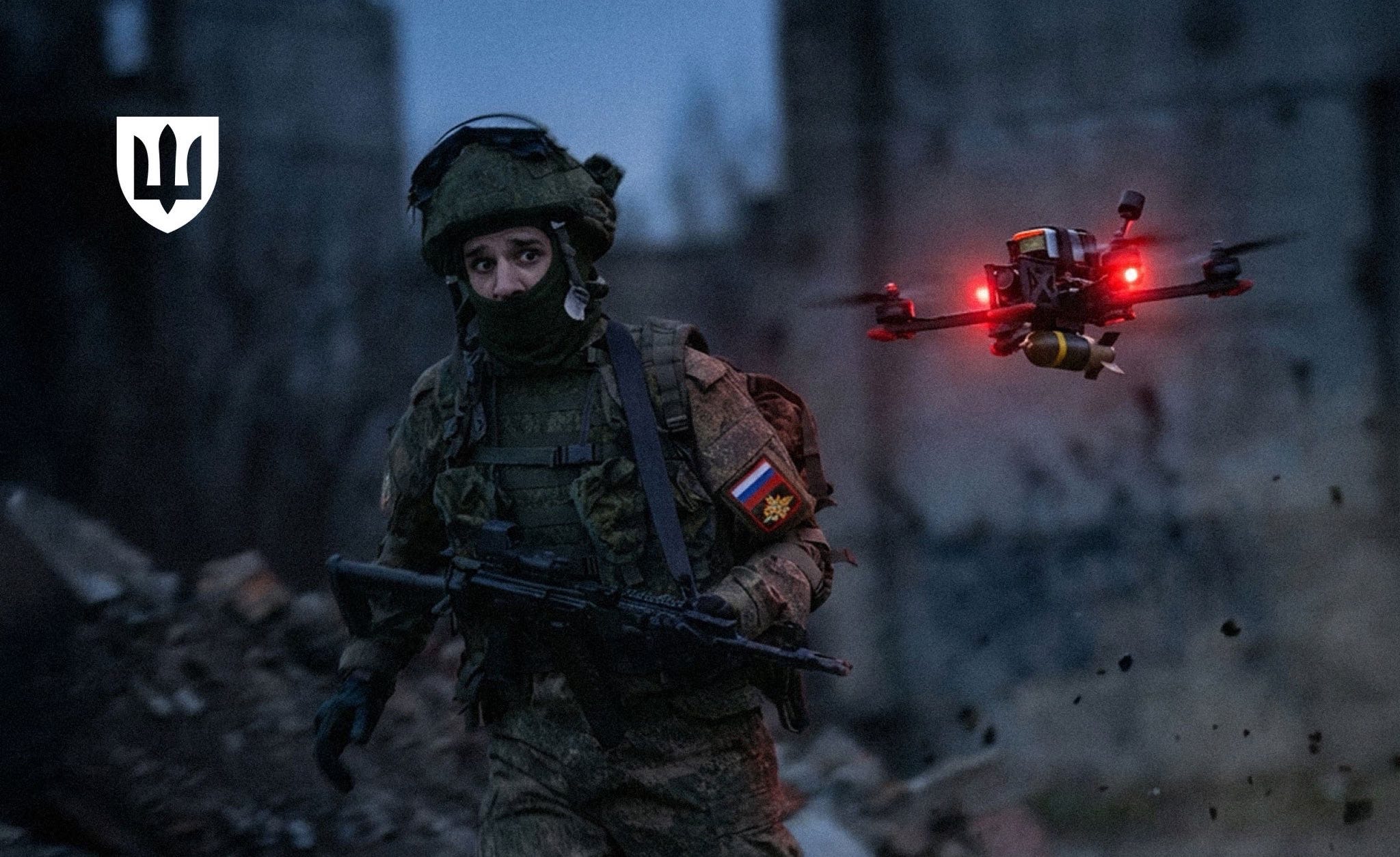
In Ukraine this week, Ukrainian forces struck deeper into Russia’s industrial heartland than at any point in the war and revealed that its Mediterranean drone campaign is being run from bases in Libya. Ukraine was also on the receiving end of a 579 drone and missile Russian aerial attack, which was partly answered by a Ukrainian Easter ceasefire proposal - answered by the Russians with continued bombardment. On the ground, Ukrainian forces have continued to hold the line in Donetsk against a Russian spring offensive that has – so far – failed to generate operational momentum.
The war in Iran continues with no clear pathway to de-escalation. Despite the speech by President Trump during the week, a theory of victory beyond “keep smashing until they surrender” has not yet emerged. America is posturing and threatening to put boots on the ground, while Iran continues to lob missiles and drones at military bases, and civil infrastructure, in countries across the Middle East.
In the Pacific, preparations continue for the forthcoming Xi-Trump summit, although given how the war in Iran is progressing, watch for another delay proposed by Trump. The defence budget impasse in Taiwan continues, and Japan deploys more long-range strike weapons to protect its territory and deter expanded Chinese military aggression in the western Pacific.
Welcome to this week’s Big Five.
Ukraine
Ukraine’s Impressive Long-Range Strikes. Ukraine’s long-range strike campaign against Russian territory reached new geographic and strategic depths during the week. The established pattern for these strikes, with precision drones targeting energy, chemical, and defence industrial nodes, continued to accelerate. Strikes are penetrating over 1,000 kilometres into Russian territory on a near-nightly basis.
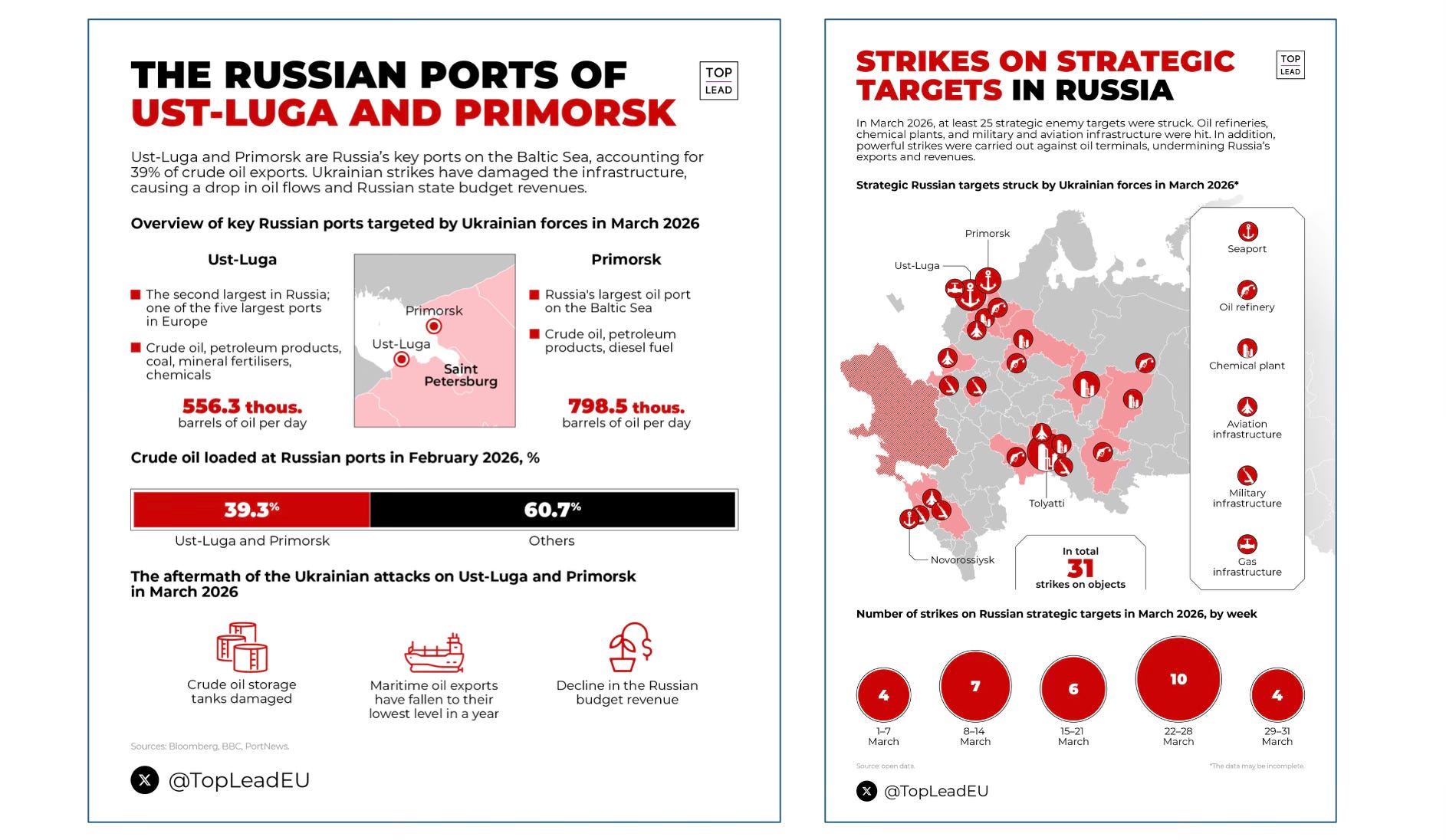
The week saw attacks on consecutive nights on Leningrad Oblast’s energy corridor. Ukraine had already struck the Novatek terminal at Ust-Luga and the Kinef refinery at Kirishi, which is one of Russia’s three largest refineries by output at 355,000 barrels per day, in late March. Ust-Luga was struck a second time on 29 March, causing renewed fires at storage and loading infrastructure.
The cumulative effect on Russia’s Baltic export capacity is significant. By late March, Reuters estimated that at least 40% of Russia’s oil shipping capacity had been disrupted, contributing to a Russian government decision to ban gasoline exports from 1 April to 30 September this year, citing reduced refinery output. Gas stations across multiple Russian regions have already run dry.
The Ukrainian strike campaign then shifted south and east. On 2 April, a major fire broke out at the Bashneft-Novoil refinery in Ufa, Bashkortostan, which is approximately 1,400 kilometres from the Ukrainian border, according to Kyiv Post. This was followed on the night of 3-4 April by a multi-drone strike on Tolyatti in Samara Oblast, targeting two major chemical sites: Tolyattikauchuk and KuibyshevAzot. Militarnyi.com reported this was the second strike on these facilities within a month, with the previous attack occurring on 11 March. KuibyshevAzot is a major producer of nitrogen fertilizers and chemical raw materials. Ukrainian drones also struck the seaport of Taganrog and mounted simultaneous attacks on Shahed launch bases in Kursk and Bryansk regions and on a fuel train in occupied Luhansk.
Ukraine’s FP-5 Flamingo cruise missile also featured in some attacks. On 28 March, Flamingo missiles struck an explosives plant in Chapaevsk, Samara Oblast. The Flamingo, with a 3,000 km range, a 1,150 kg warhead, is bringing all of Russia’s European industrial and defence complex within reach. Its operational use is accelerating; from the Votkinsk missile plant in February to the Samara explosives cluster in March.
President Zelensky noted on March 30 that some allied partners had requested a scaling back of energy strikes due to rising global oil prices driven by the Iran war. He offered a reciprocal deal; Ukraine would halt energy strikes if Russia stopped striking Ukrainian energy infrastructure. Moscow neither acknowledged nor accepted the offer.
Ukraine’s Mediterranean strike operations. The most interesting intelligence story of the week was published on 3 April by French broadcaster RFI. It published an investigation that confirmed Ukraine is conducting a Mediterranean maritime campaign from bases in Libya. One of those operations may have killed a senior Russian intelligence general.
The RFI investigation, confirmed by Euronews, found that over 200 Ukrainian officers and technical specialists are stationed at three sites in western Libya, operating in coordination with the Tripoli government. The primary infrastructure includes a drone launch facility near the Mellitah Oil and Gas Complex in Zawiya, with direct sea access, and a presence at the Air Force Academy in Misrata. A third site at the headquarters of Libya’s 111th Brigade facilitates coordination between Ukrainian and Libyan military officials. This infrastructure has given Ukraine a drone corridor covering the central and western Mediterranean.
It might be described as Ukraine’s Mediterranean drone line!
The 3 March strike that sank the Russian LNG carrier Arctic Metagaz, a sanctioned vessel carrying 62,000 tonnes of LNG to Egypt, was confirmed as a Ukrainian operation using a Magura V5 naval drone. The vessel caught fire and sank in international waters southeast of Malta.
RFI also reported that the December 2025 strike on the shadow fleet tanker Qendil, the first-ever Ukrainian drone attack on a Mediterranean vessel, may also have killed GRU General Andrey Averyanov. Averyanov is widely linked by Western investigators to the Vrbětice ammunition depot explosions in Czechia, as well as other assassination and sabotage operations across Europe. Reporting cited by Nashaniva indicates that around ten senior Russian intelligence officers were aboard the Qendil, travelling disguised as crew. The strike resulted in two deaths and seven injuries. Moscow has not commented officially.
The strategic dimension of Ukraine’s Mediterranean campaign extends well beyond attacking Russian ships. Russia’s shadow fleet, which is estimated at over 3,000 vessels, is the primary mechanism for Moscow to circumvent Western energy sanctions and keep oil revenues flowing to finance its war against Ukraine. While this strike campaign occurs, Ukraine has concurrently been developing next-generation open-ocean naval drones under an agreement with the United Kingdom, encompassing joint production, R&D, and an AI Centre of Excellence in Kyiv. The trajectory of the Mediterranean strike campaign appears to be taking the lessons of Ukraine’s Black Sea naval drone campaign and transforming it into a wider, potentially globe-spanning, maritime interdiction capability.
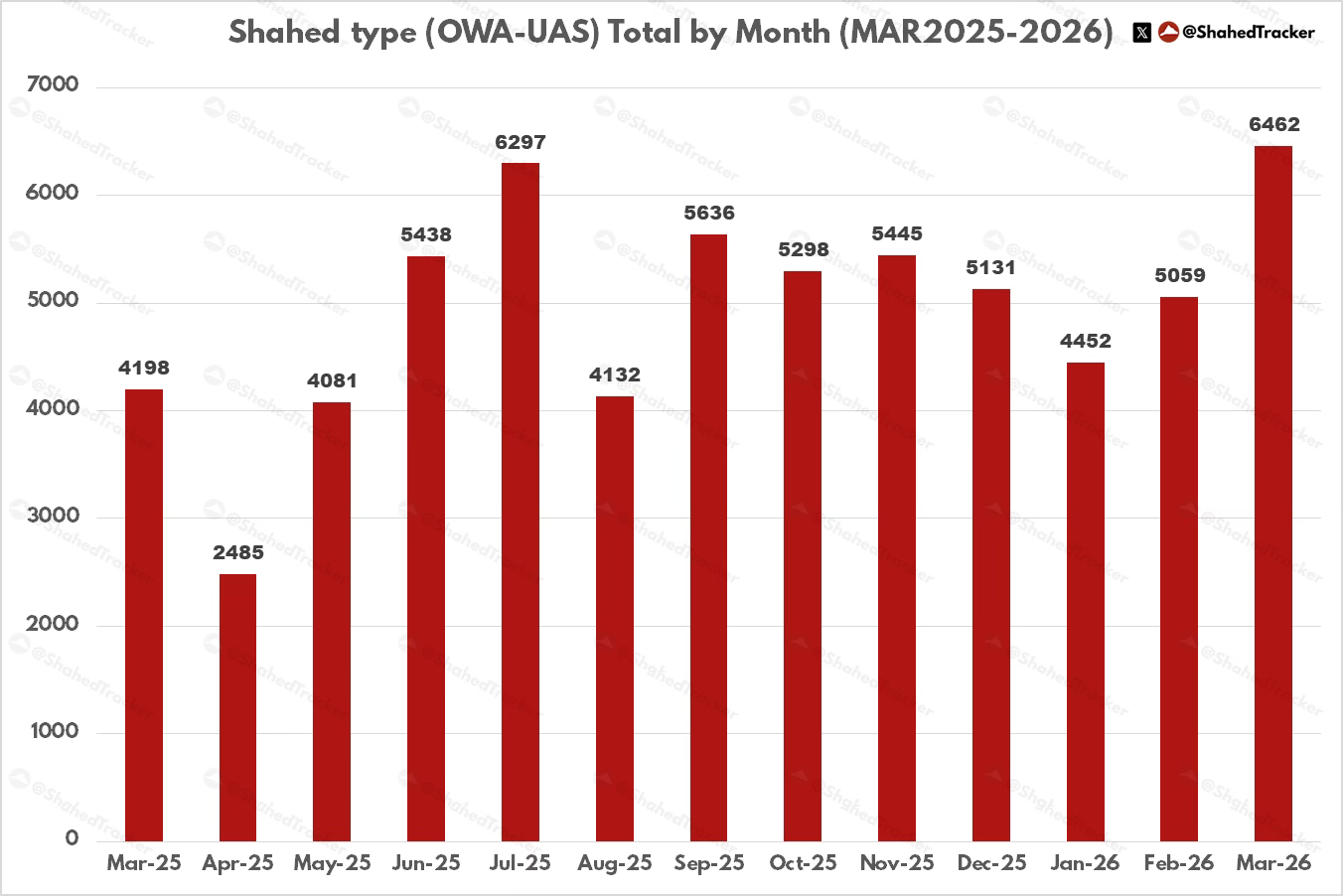
Russian Strikes Against Ukraine. Russia’s aerial bombardment campaign continued this week. AFP analysis of Ukrainian Air Force data confirmed that Russia fired at least 6,462 long-range drones against Ukraine in March 2026. This is the highest monthly total since the full-scale invasion began, up 28% over February 2026. Ukraine’s air force achieved a near-90% interception rate across the month, the highest since February 2025. The Shahed Tracker feed on X also issued its latest graphs which supports this analysis.
The biggest strike of the week took place on the night of 2-3 April. According to Ukrainian Air Force figures, Russia launched 579 aerial attack assets in a combined strike: 10 Iskander-M ballistic missiles, 25 Kh-101 cruise missiles, 2 Iskander-K cruise missiles, and 542 strike drones from multiple launch sites. Ukrainian air defences destroyed 541 of the 579 targets launched - a 93% interception rate. Eleven missiles and 27 drones got through, striking 20 locations. The attack killed at least four people and injured over 30, damaged residential buildings, a shopping mall in Sumy city centre, a veterinary clinic in Fastiv, and high-rise apartment buildings in Kyiv Oblast. Kharkiv also suffered 37 strikes across two days. Zelensky told Ukrainians that this barrage was Russia’s answer to his Easter ceasefire proposal.
ISW’s 3 April assessment flagged a significant future threat: Russian forces will likely shift their long-range strike campaign toward Ukrainian water supply and logistics targets in Spring and Summer 2026. This represents a new form of strategic coercion, targeting the infrastructure that sustains civilian life and military supply chains simultaneously. The Russian shift to daytime attacks, first documented in the 24 March mass barrage of 948 weapons, has also continued. Russia’s method, exhausting Ukrainian air defences overnight then following with daytime swarms, exploits the finite capacity of any layered air defence system. On 4 April, Russia launched a further 286 drones overnight, sustaining pressure with barely a pause.
The Ground War: Ukraine Holding Firm. On the ground, the key story of this week is the continued pressure of Russia’s spring-summer offensive. Ukraine’s Donetsk Fortress Belt, the 50-kilometre arc of fortified cities from Sloviansk through Kramatorsk to Druzhkivka and Kostiantynivka, remains the Russian main effort. Supporting efforts are underway in Luhansk, Kharkiv and southern Ukraine.
Thus far, the Russians have failed to generate any operational momentum with their spring offensive.
The Russia Matters April 1 report card provides useful temporal context: Russia gained 17 square miles in the week of 24-31 March, reversing a period of Ukrainian counteroffensive success in the south. Russian gains for the same period last year were 47 square miles.
On 1 April, Russia’s Defence Ministry declared it had ‘completed the liberation’ of Luhansk Oblast, covering the remaining 0.2% of Ukrainian-held territory there.
On the Pokrovsk axis, fighting continued near Bilytske, Rodynske, Myrnohrad, Hryshyne, and Novyi Donbas, with Russian groupings advancing slowly toward Dobropillia. Ukraine’s 3rd Assault Brigade and Air Assault formations continue to hold the line at significant cost. Russia’s own losses are also accumulating at record rates: Zelensky reported on 4 April, citing British intelligence, that Russian losses in March reached their highest level of the war, with drone strikes alone killing or seriously wounding 33,988 troops in a single month. Russia’s training cycle for assault units has reportedly been reduced from one month to one week to compensate for attrition — a desperate measure that degrades the quality of those being fed into the assault.
In western Zaporizhzhia Oblast, Ukrainian forces have recently advanced. This builds on the Ukrainian counterattacks on the Oleksandrivka and Hulyaipole axes of advance in late January. These gains continue to impose dilemmas on Russian planning, requiring military commanders to choose between supporting its spring offensive in Donetsk or shoring up its deteriorating positions in the south.
While the Russian spring offensive is probably not achieving the ground it had aimed to so far, it is much too early to call it a failed offensive. There are months of hard fighting ahead, and a range of different scenarios that could play out. While Ukrainian tactical and operational effectiveness has improved along the frontline, there remain multiple vulnerabilities that Russian ground forces might exploit to gain more terrain in the coming months.
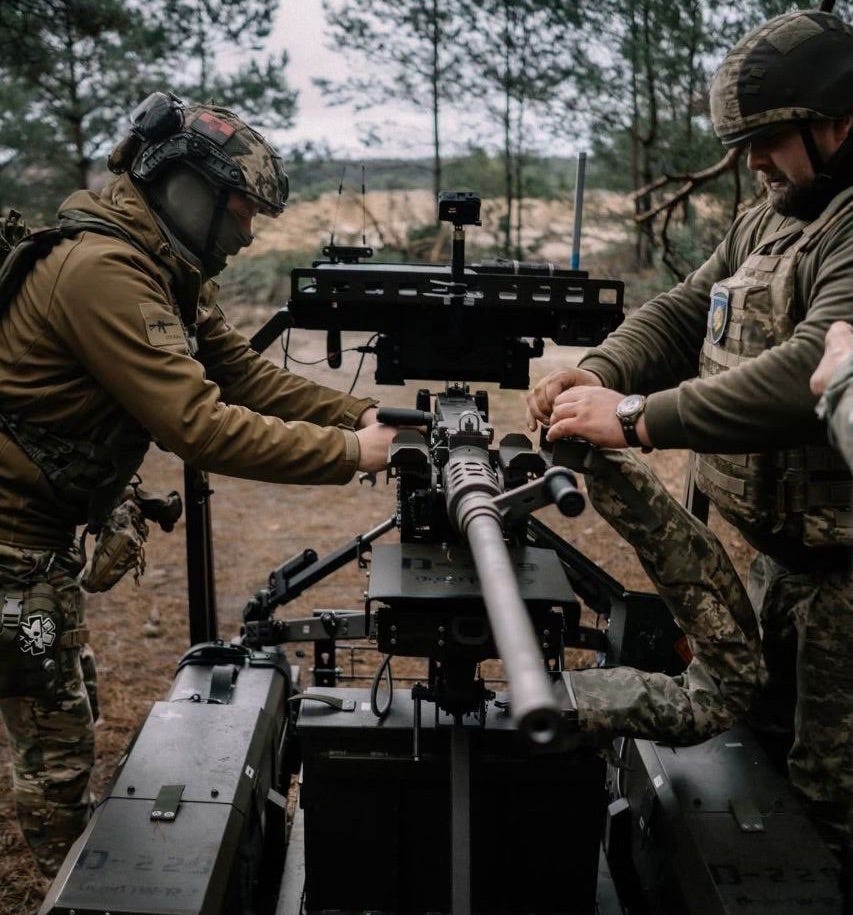
The accelerating Unmanned Ground Vehicle (UGV) contribution. Ukraine’s unmanned ground vehicle programme has moved decisively from the experimental phase to industrial deployment. The operational consequences are beginning to reshape frontline dynamics – and provide vital information for the development of new tactics, organisations and training regimes for the Ukrainian ground forces.
Ukraine’s K2 Brigade now commands what military sources and BBC reporting describe as the world’s first dedicated UGV battalion, led by Major Oleksandr Afanasiev. The unit operates wheeled and tracked platforms carrying Kalashnikov machine guns into positions where no infantryman would willingly go.
Other recent examples of the employment of combat UGVs include:
A 33rd Mechanised Brigade UGV armed with a machine gun ambushed a Russian armoured personnel carrier. Ukrainska Pravda reported that the T-700 Browning UGV carries a 12.7mm M2 and a 7.62mm PKT simultaneously, while the larger Vatag is being developed for a 25mm Bushmaster autocannon.
One DevDroid TW 12.7 system held a frontline position for 45 consecutive days, reloaded every 48 hours.
Three Russian soldiers surrendered to a Ukrainian UGV near Lyman in January. This was possibly the first recorded case in warfare of troops capitulating to a remotely piloted ground vehicle.
As reported by the Kyiv Independent on 4 April, a Zmiy unmanned ground vehicle was deployed by the 12th Special Purpose Brigade ‘Azov’ to approach a fire involving gas canisters in Kramatorsk, handling a situation too dangerous for human firefighters.
The production numbers of UGVs this year are what make this operationally significant. The Modern War Institute assessed that Ukrainian industry delivered 15,000 UGVs to frontline units in 2025, up from 2,000 in 2024. Ukrainian manufacturer Tencore produced over 2,000 UGVs in 2025; it now expects orders for approximately 40,000 units in 2026, with 10–15% armed.
In the 3rd Assault Brigade, UGVs now handle 80% of logistics operations; in the contested cities of Pokrovsk and Myrnohrad, that figure reaches 90%. Brigadier General Biletsky, commander of the 3rd Army Corps, has assessed that units integrating UGVs could reduce frontline infantry requirements by up to 30% by year’s end. This is critical for a ground force whose frontline average age is now 43–45 and whose manpower deficit is estimated at 300,000.
The multi-mission character of UGVs, including logistics, combat and emergency response, sees them having wide utility. Former Commander-in-Chief and UK Ambassador Valerii Zaluzhnyi has recently spoken publicly about what he believes comes next: AI-powered swarms of aerial, ground, and maritime drones attacking simultaneously from multiple directions. The technical prerequisites are already in development at Ukraine’s frontline workshops.
In related news, Ukraine’s heroic firefighters have now started using UGVs as well. See the story here.
Diplomatic Negotiations. The diplomatic picture over this period was defined by three elements: Ukraine’s attempts to create diplomatic openings; Russia’s continued rejection of any settlement short of capitulation, and signs that the United States may be preparing to re-engage directly from Kyiv.
On 31 March, President Zelensky formally proposed an Easter ceasefire to U.S. envoys Steve Witkoff and Jared Kushner via online talks that also included NATO Secretary General Mark Rutte, Senator Lindsey Graham, and Presidential Office head Kyrylo Budanov. Zelensky described the call as ‘positive’ and said the two sides “agreed that teams will remain in close contact over the coming days to strengthen the security guarantees document between Ukraine and the United States.” He asked the American team to relay his Easter truce proposal to Moscow, framing it explicitly: a pause over Orthodox Easter could demonstrate that diplomacy is capable of delivering results.
The Kremlin’s response was delivered both verbally and through action on the battlefield. Russian spokesman Peskov told reporters that Zelensky’s statements contained no “clearly formulated initiative for an Easter ceasefire.” Afterwards, Russia launched 700-plus drones on 1 April. Then a 579-weapon barrage on 2-3 April. Russia has also, according to Zelensky, informed the United States it could seize the remainder of Donetsk Oblast within two months. Given the state of Russia’s offensive described above, this claim is implausible. But it (again) reveals Moscow’s preferred theory of victory: manufacture a fake “reality on the ground” to pressure Washington into squeezing Zelenskyy for concessions.
The most significant diplomatic development of the period was reported by Reuters in the past 24 hours. Presidential aide Budanov confirmed that Witkoff, Kushner, and Senator Lindsey Graham are expected to visit Kyiv shortly after Easter. This is the first time either U.S. envoy would have set foot in Ukraine. The talks stalled following the beginning of U.S.-Israeli strikes on Iran. A Kyiv visit would represent their resumption.
Zelensky has been consistent in calling for Ukrainian sovereignty to be maintained in any settlement, for security guarantees prior to any deal, and for direct leader-level talks. Whether a Kyiv visit by the U.S. team translates into meaningful diplomatic momentum, or yet another round of managed expectations, remains an important question.
Iran
Trump’s Iran Crusade. In yet another Trumpian rhetorical ramble, the American leader stated that “Remember when I gave Iran ten days to MAKE A DEAL or OPEN UP THE HORMUZ STRAIT. Time is running out - 48 hours before all Hell will reign down on them. Glory be to GOD!” This is hardly the first, and won’t be the last, threat that Trump has made directed at the Iranian regime.

Interestingly, he finished his bleat with the phrase “Glory be to God”. This is a weird and quite unusual way from an American war leader to finish a message in the modern world. Some modern Islamist narratives have reframed western military forces in the Middle East as a persistent, foundational assault on Islamic lands. Watch for the next round of Iranian strategic influence operations to feature narratives about Western crusaders.
Assessing the War So Far. This week I published two articles related to the war in Iran. The first, published by the Lowy Interpreter, was called “A Land War Illusion?” and explores the potential employment of ground forces in the Iran campaign. The second, “After the Fury: War, Allies, and the World America Is Making”, was published here at Futura Doctrina and explores the longer term impact on American alliances and the global security environment of the current war against Iran. Together they comprise an analytical framework for understanding where Operation Epic Fury might be taking America - militarily, strategically, and diplomatically.
My first article explores the possibility of American land operations inside Iran. My central argument is simple and sobering: ground forces can be decisive, but only when employed at scale, against the right mission, with clear political objectives. None of those conditions are obviously present at the moment. Iran is a large, mountainous country with a substantial army and the Islamic Revolutionary Guard Corps. The Strait of Hormuz’s 200-kilometre Iranian shoreline means the Americans must protect every inch while the Iranians need only threaten any one of them. Russia is already sharing intelligence with Tehran and would relish the opportunity to help kill American soldiers. In the piece I also draw on J.C. Wylie’s dictum that the ultimate determinant in war is the man on the scene with a gun: Trump risks breaking not Iran’s will, but his own.
My second piece examines the broader strategic picture following Trump’s 2 April address. The military campaign after 33 days of Operation Epic Fury is quite remarkable: over 12,300 targets struck, Iran’s navy destroyed, Khamenei killed, missile production degraded to zero. But my key argument is that military statistics are insufficient for strategic assessment. The war has strained NATO to its foundations: Spain closed its airspace, Italy denied basing rights, Germany ruled out involvement, and allies across Europe and the Indo-Pacific declined to send warships to the Strait. Trump’s demand for “delayed courage” from allies carries an explicit warning: the era of American security extended as a matter of solidarity, regardless of allied contribution, is over.
Together, my two articles comprise a unified argument: military power unmoored from coherent political objectives, good strategy and alliance management produces strategic outcomes that undermine the original war aims. The war’s three possible trajectories - negotiated settlement, escalation toward land operations, or prolonged de-escalation - all carry significant risk. A crucial question that remains to be answered is whether the world America is engaged in making is the one it actually intends.
The Pacific
Trump-Xi Summit Postponement and Strategic Implications. Beijing never formally confirmed the March dates and has not provided an official response to the delay proposed by President Trump. Chinese sources told CNN the delay could strengthen Beijing’s hand. If the war in Iran continues as it is, with Trump appearing to lose control of the conflict which is threatening global oil supplies and economic growth, it might reveal American weakness. The longer the war continues, the more likely it is that Trump might again delay the summit.
KMT Chairwoman to Meet Xi Ahead of Trump Summit. KMT Chairwoman Cheng Li-wun ‘gladly’ accepted on 30 March an invitation to meet Xi Jinping in Beijing next month, promising to advocate cross-strait peace. Cheng stated that “we want to prove to the people of Taiwan and the entire world that conflict between the two sides of the strait is not inevitable.“ Cheng emphasized she “should also ask Xi Jinping: When is China going to elect its president?” The timing, several weeks before the rescheduled Trump-Xi summit, is an opportunity for Xi to showcase an alternative Taiwanese political view that is more open to cross-strait dialogue.
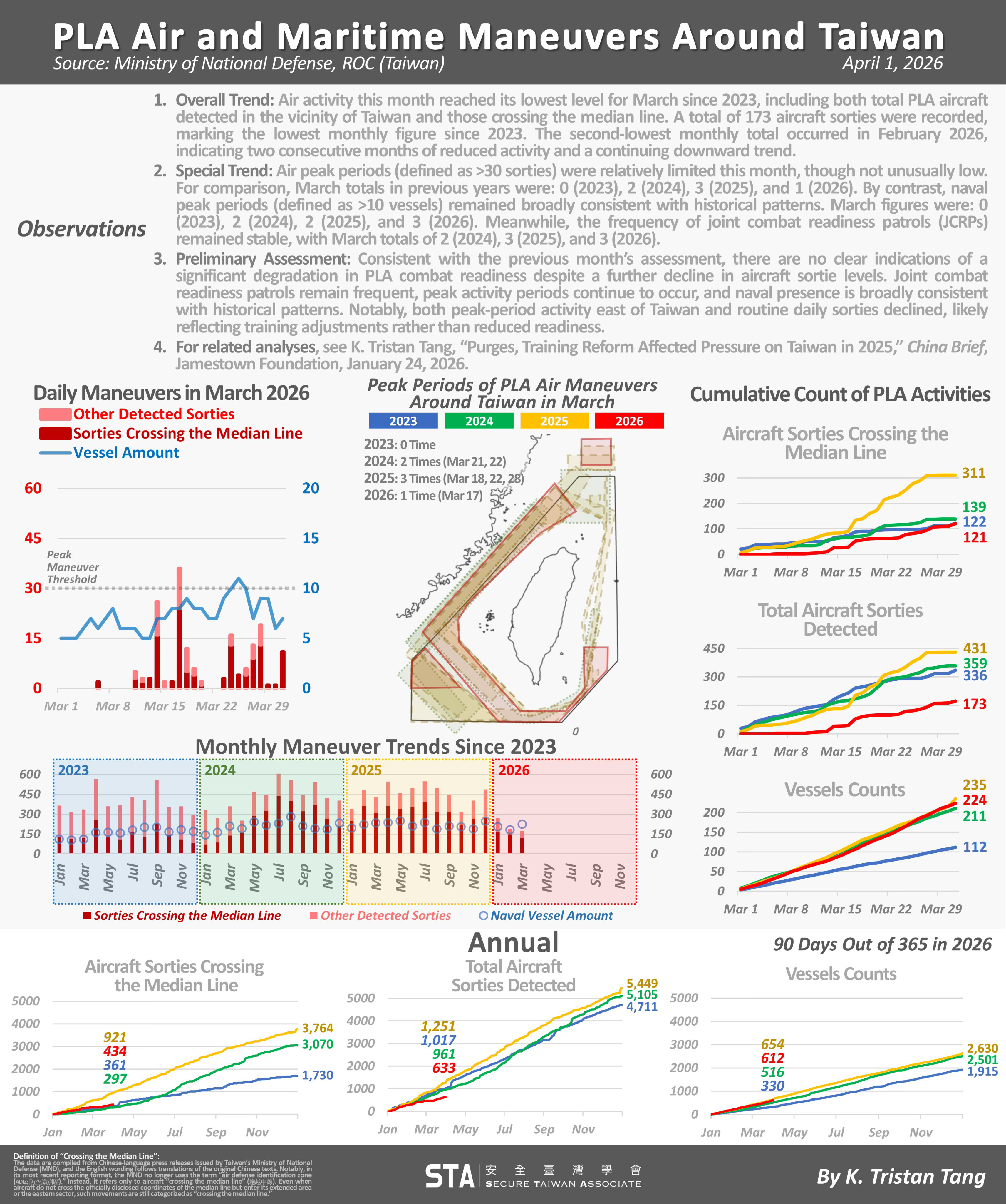
PLA Operations Around Taiwan. This week, @KTristanTang issued his monthly update on PLA operations around Taiwan. His assessment: “Consistent with the previous month’s assessment, there are no clear indications of a significant degradation in PLA combat readiness despite a further decline in aircraft sortie levels. Joint combat readiness patrols remain frequent, peak activity periods continue to occur, and naval presence is broadly consistent with historical patterns. Notably, both peak-period activity east of Taiwan and routine daily sorties declined, likely reflecting training adjustments rather than reduced readiness.” See more below.
U.S. Senate Delegation Pressures Taiwan on Defense Budget. Four U.S. senators - Jeanne Shaheen (D-NH), John Curtis (R-UT), Thom Tillis (R-NC), and Jacky Rosen (D-NV) - arrived in Taiwan on 30 March for a two-day visit pressing for legislative approval of the NT$1.25 trillion (US$40 billion) special defense budget stalled by opposition. President Lai told the delegation the delays stemmed from “political factors” but insisted Taipei’s commitment to self-defence “has not changed in the slightest.” Senator Curtis personally endorsed the special defense budget, stating that “back in Washington, D.C., my colleagues are watching. We want to make sure that as we invest in this part of the world, you are also investing, and that we’re in this together.”
Japan Deploys First Long-Range Strike Capabilities. Japan deployed its first long-range missiles on 31 March, operationalizing upgraded Type-12 land-to-ship missiles at Camp Kengun in Kumamoto prefecture. Defense Minister Koizumi stated “as Japan faces the most severe and complex security environment in the postwar era, it is an extremely important capability to strengthen Japan’s deterrence and responsiveness. It demonstrates Japan’s firm determination and capability to defend itself.”
The upgraded Type-12 missiles have a 1,000-kilometer range—a fivefold extension from the original 200-kilometer range. This range allows the missiles to reach mainland China. Simultaneously, Japan deployed a hypersonic glide vehicle at Camp Fuji west of Tokyo, designed specifically for island defence. More deployments at locations including Hokkaido in the north and Miyazaki in the south are planned by March 2028.
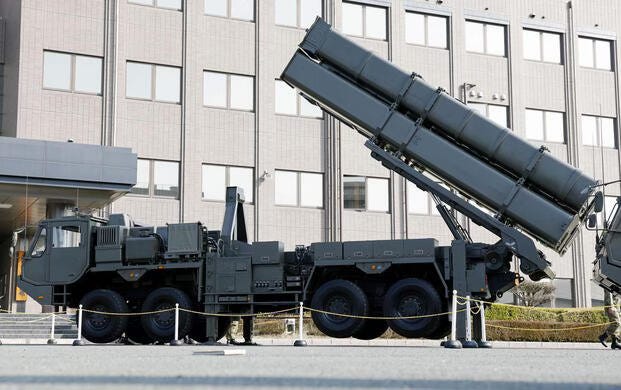
Japan is also planning to deploy US-made Tomahawk cruise missiles (1,600-kilometer range) on the JMSDF destroyer JS Chokai later this year, the first of eight destroyers to be equipped with the missile. This layered capability, with Type-12 missiles for regional strike, hypersonic glide vehicles for island defence, and Tomahawks for extended-range precision, represents Japan’s most significant offensive capability development since the Pacific War.
The missile deployments took place on the day the Trump-Xi summit was originally scheduled, and amid the U.S. Senate delegation’s Taiwan visit. This may not be coincidental. Japan continues to fortify its southwestern islands near the East China Sea while China’s economic and diplomatic coercion intensifies.
PLA Naval Capabilities and Type 055 Air Defense Role. The ODNI’s 2026 Annual Threat Assessment stated that China likely will not invade Taiwan in 2027 but will continue coercive efforts throughout the Indo-Pacific. The assessment noted China’s strengthening presence in the South China Sea ‘particularly at the Philippine-claimed Scarborough Reef and Second Thomas Shoal, through persistent military and coast guard patrols and diplomatic and legal actions,’ including establishing a nature reserve at Scarborough Shoal to increase legal cover for aggressive actions against Philippine vessels.
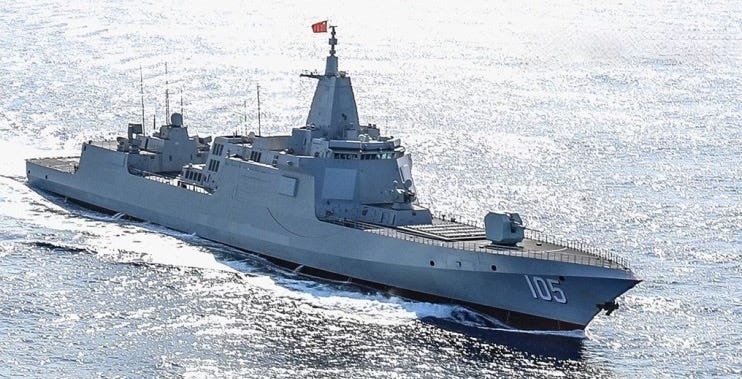
A recent AEI/ISW assessment notes the PLA likely emphasizes the Type 055’s air defense role in light of US military successes in Venezuela and Iran. The Type 055 DDGs may conduct air defense missions against the United States during conflict, though an air defense role would prevent at least some portion of the PLAN’s 10 Type 055s from escorting aircraft carriers during Western Pacific missions, significantly limiting carrier strike group combat power. This creates targetable vulnerabilities; the U.S. can impose dilemmas that could force the PLAN to remain within the first island chain, limiting its interdiction of U.S. support for Taiwan.
The ODNI assessment that China likely will not invade Taiwan in 2027 should not provide too much strategic comfort, however. It assesses only that China probably judges 2027 as premature, not that the overall trajectory has changed.
****************
It’s time to explore this week’s recommended readings.
In this week’s Big Five, I have included a terrific article on Russia’s experiments with its own version of Ukraine’s ‘drone line’, as well as articles on U.S. Navy learning and adaptation, Ukraine’s defence industry, Chinese support for Iran’s drone industry and an update on Iran’s remaining missile launch capacity.
As always, if you only have the time available to read one of my recommendations, the first is my pick of the week.
Happy reading!
1. Sharpening Neptune’s Trident

For many years, renowned retired U.S. Marine and academic Frank Hoffman has written about the future of war, and how learning and adaptation are inherent in the military profession. In this new article published by Proceedings, Frank teams with Pat Garrett to explore a range of areas where the U.S. Navy might improve its ability to learn, adapt and win future wars. The article can be read at this link.
2. Europe’s Untapped Arsenal
For some time, at least a couple of years, it has been clear to anyone that looked that Ukraine was building an impressive 21st century defence industry. It has only been with Iran’s use of Shahed drones against its neighbours that many in the Middle East and wider West have now paid attention to very interesting indigenous Ukrainian capabilities, including its unique drone interceptors. This article published by Foreign Affairs provides a useful insight into the development of Ukraine’s new defence industries and how it can help Europe to defend itself. The article is available at this link.
3. Russia’s Drone Line Experiment
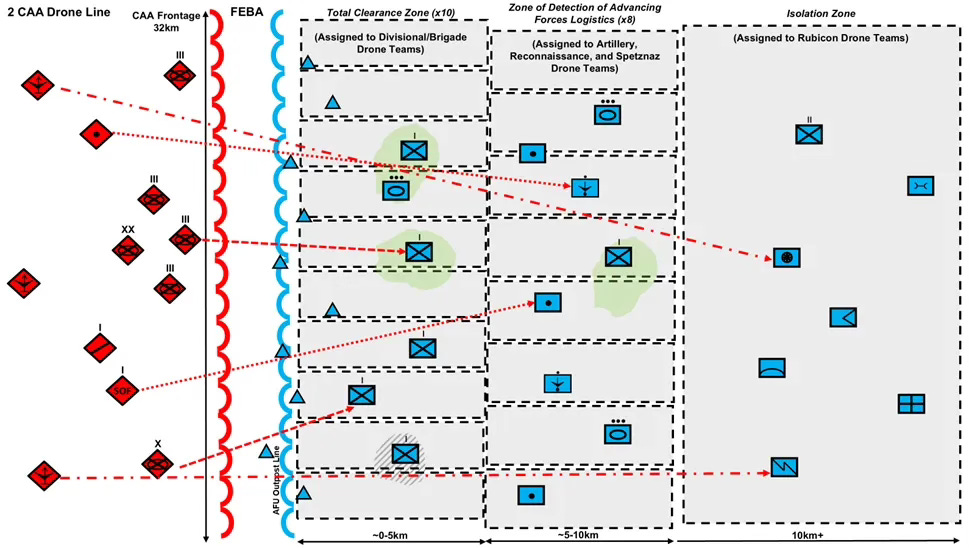
Rob Lee and Dmytro Putiata have been covering developments in land combat in Ukraine since the earliest days of Russia’s full-scale invasion in 2022. In their latest collaboration, written for their new substack called “Two Marines”, Rob and Dmytro explore the topic of Russian front line drone operations and how the Russian Army has evolved drone operations in the close and deep battles. It is an excellent, well-informed piece, and can be read at this link.
4. China’s Support for Iranian Drones
This piece, published by the Jamestown Foundation, examines how China has supported Iran’s development and production of the many drones that it has been employing against America, Israel and nations across the Middle East since the start of the war there in late February. As the article notes, “in March 2026, Iran’s drone campaign consumed thousands of expendable unmanned aerial vehicles (UAVs). The critical technologies, manufacturing equipment, and components underpinning these platforms trace to the civilian manufacturing ecosystem of the People’s Republic of China (PRC), channeled through private capital acquisition, reverse engineering, and the systematic exploitation of dual-use trade ambiguities.” You can read the full piece at this link.
5. Iran’s Remaining Missile Launch Capability
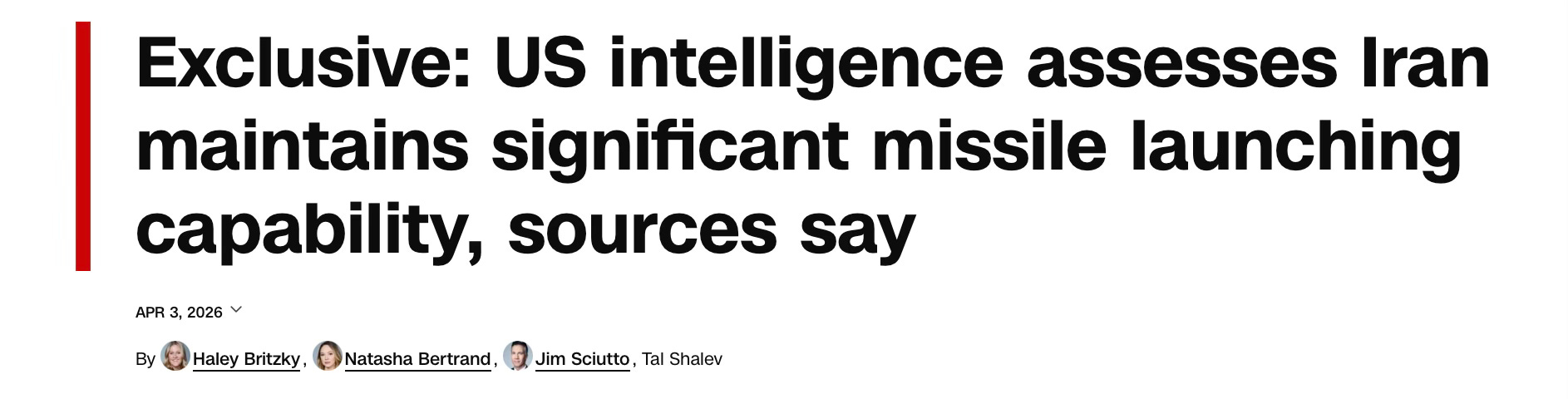
In this article from CNN, the authors examine the degree to which the U.S.-Israel air campaign has degraded Iran’s long and medium range missile capacity. As the article notes, “roughly half of Iran’s missile launchers are still intact and thousands of one-way attack drones remain in Iran’s arsenal despite the daily pounding by US and Israeli strikes against military targets over the past five weeks, according to recent US intelligence assessments, three sources familiar with the intel told CNN.” You can read the full piece here.
Great update. Brings together so much mateial and allows for a deeper dive. Really appreciate your work.
Thank you for your excellent update. Happy Easter to all.