
Taiwan’s mobilisation model
An article based on research from my recent Taiwan trip that explores Taiwan's evolved approach to national mobilisation and what we can learn from it.

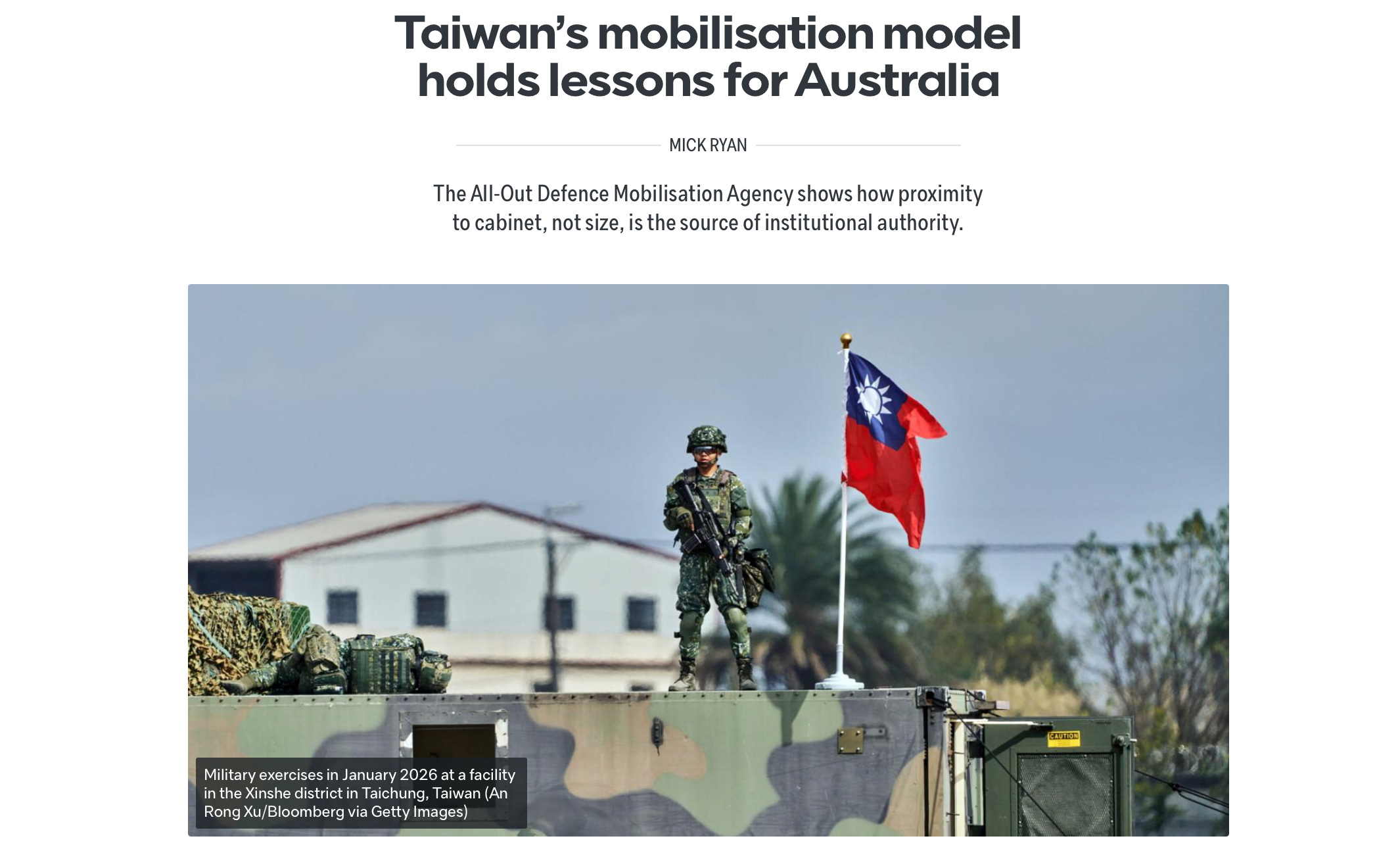
What ADMA’s architects understand – and Kyiv’s defenders have demonstrated since 2022 – is that modern national defence is not a military problem alone.
Australia’s recently released National Defence Strategy highlighted the need for enhanced national resilience. However, it contained no discussion about how Australia might mobilise as a nation for future threats, nor how the nation might undertake a transition from peace to conflict. A recent visit to Taiwan, including discussions with the commander of the new All-Out Defence Mobilisation Agency (ADMA), offered insights that can inform an Australian debate on these topics.
Taiwan has constructed one of the most sophisticated whole-of-society defence architectures in the Indo-Pacific. What ADMA has built over the past several years is not bureaucratic innovation for its own sake. It is a serious institutional response to a proximate military threat.
ADMA was formally established in January 2022, but its foundations were laid earlier. Between 2018 and 2019, Taiwan undertook a series of military, strategic and organisational design reviews that exposed fundamental gaps in how it would resist Chinese military campaigns and coordinate civil and military capacity in a crisis.
The reforms that followed addressed three interrelated problems: fragmented coordination across government agencies; the absence of legal frameworks for faster action in conflict; and the lack of a central body capable of integrating the full machinery of government.
While this case for reform predated Russia’s full-scale invasion of Ukraine, the war in Ukraine subsequently became an important reference point for Taiwan. What ADMA’s architects understand – and Kyiv’s defenders have demonstrated since 2022 – is that modern national defence is not a military problem alone. Military forces may fight, but it is societies that sustain wars. The orchestration of government, industry, and civil society into a functioning and sustained wartime endeavour matters as much as military force structure at the start of a war.
Ukraine’s influence on ADMA’s approach is openly acknowledged by the Taiwanese. The Ukrainian experience – a society mobilised in spirit, in organisation, and through the dispersal of critical functions to reduce vulnerability – shaped Taiwan’s efforts to build societal resilience.
The all-out defence mindset ADMA seeks to instil in Taiwan’s citizenry draws explicitly on this experience. Officials regard the agency’s operations as an explicit counter to Chinese cognitive warfare. By demonstrating the depth and resilience of Taiwan’s mobilisation capacity and societal will, ADMA signals to Beijing that any military campaign will not produce a quick or clean result. Officials believe the enhanced mobilisation posture has itself changed China’s strategic calculus, forcing adaptation in Chinese planning. That makes ADMA not just a coordination body but an active component of Taiwan’s strategic deterrent.
The insights from ADMA extend beyond its responsibilities. Where it sits and how it is structured are also important. ADMA is not an independent ministry. In peacetime it operates primarily as a policy body, subordinate to the Ministry of National Defence, with no direct command authority over military or civil assets.
What it does have is a cross-government mandate: it provides recommendations to the mobilisation committee of the national cabinet, for which it also serves as secretariat. That proximity to cabinet – not a large bureaucracy or direct command authority – is the source of its authority and its effectiveness.
In wartime, the agency transitions in structure and functions. ADMA would shift from its peacetime policy and secretariat role to become a joint coordination centre, linked into regional and local coordination agencies across the island. Critically, this is rehearsed regularly as part of Taiwan’s national mobilisation drills. Officials I spoke with noted that wartime coordination arrangements were being actively exercised during my visit.
The need for this frequent rehearsal of wartime functions is based on a sobering assumption: the PLA can move directly from large-scale training to military operations rapidly. The time between Taiwan’s strategic decision and the full activation of wartime structures must be measured in hours, not days. Rehearsals in peacetime are not an administrative exercise but a strategic necessity.
The full article is available to read at the Lowy Interpreter, at this link.