
The Adaptation War Deepens
Authoritarian collaboration since November 2025, and why Western strategists must urgently build and execute a strategy to confront it.

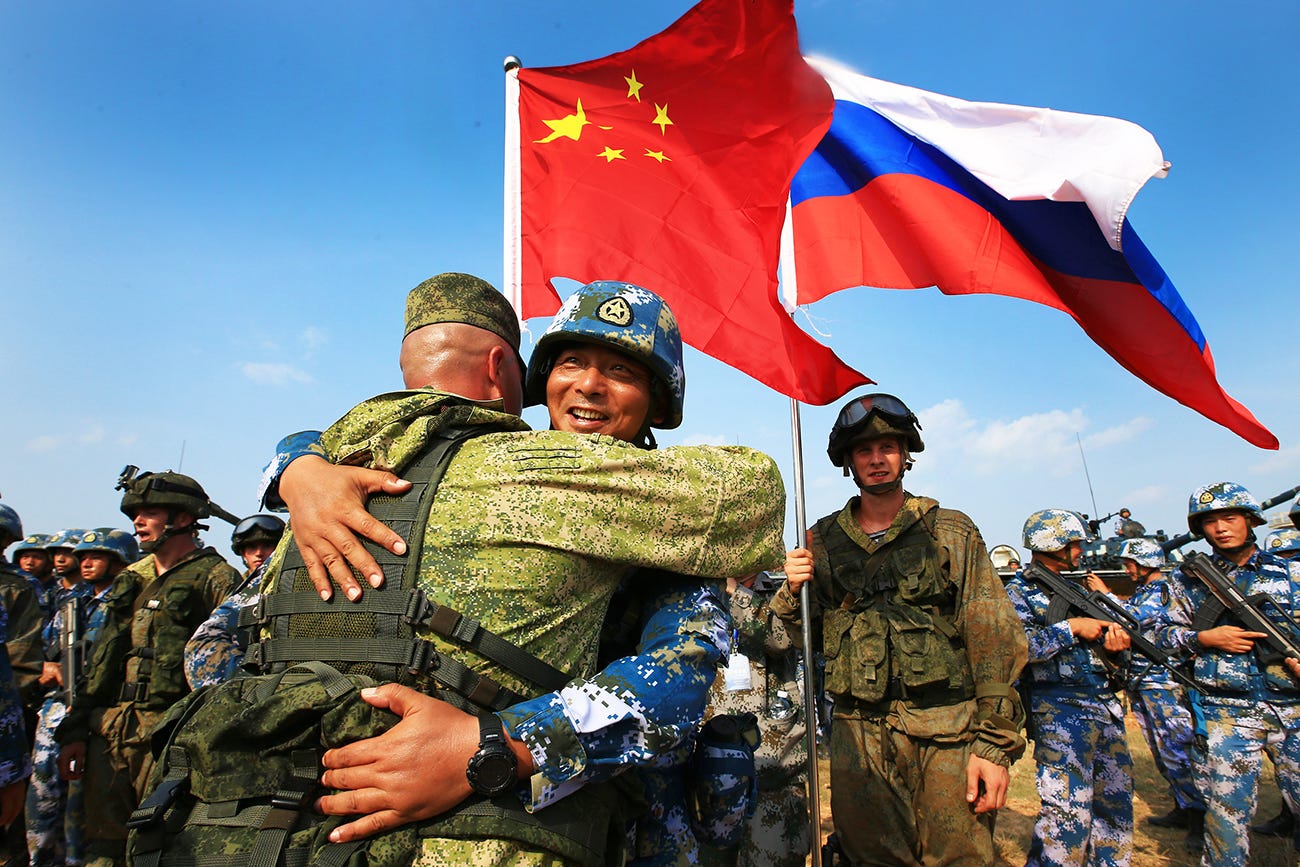
While China, Russia, Iran, and North Korea individually pose a significant threat to U.S. interests, their growing cooperation collectively magnifies the challenge. Each is emboldened to undertake actions it could not sustain on its own, and their cooperative efforts make it far more difficult to secure U.S. national security, economic prosperity, and peace and stability around the world. Cooperation among the “axis” countries has deepened since Russia’s full-scale invasion of Ukraine in 2022, as Russia has drawn on China, Iran, and North Korea to support its war efforts and to help it overcome the subsequent international condemnation and sanctions…China has played the central diplomatic, economic, and financial role in this informal alignment.
When I published Adaptation War with the Special Competitive Studies Project late last year, I argued that China, Russia, Iran and North Korea had assembled a connected knowledge market on twenty-first-century war and strategic competition.
This should not be construed as a formal alliance. Instead, I offered the evidence for a mesh of agreements and strategic partnerships through which the big four authoritarian regimes trade weapons, components, targeting data, insights on production, sanctions busting and coercion, and, most consequentially, analyses and lessons on a wide array of tactical, operational and strategic issues.
In the months since then, the weight of evidence behind this proposition has only mounted. This article surveys the developments in their collaboration since late 2025, restates the characteristics of the Adaptation War they are waging against the West, and closes with recommendations for American and allied policymakers.
Characterising the Adaptation War
Before I launch into the developments in this deepening Adaptation War in 2026, it is worth recapping the core characteristics of the new Adaptation War, and how the authoritarian learning and adaptation bloc operates.
Concurrency. Learning and adaptation are occurring at many different levels, in many different organisations, across multiple geographic regions at once. It is a multi-domain environment, spanning the ground, air, space, maritime, cyber and information domains. This parallel activity complicates any effort to understand the whole. Yet its very complexity, because learning is a human endeavour, also unveils gaps and vulnerabilities in adversaries and in our allies.
One Learns, All Can Learn. For the first time in human history, the Adaptation War has created the potential for a real-time knowledge market among authoritarians. Where learning once took years to be absorbed into an organisation, and longer still to share between organisations and nations, members of the community can now access a lesson almost as soon as one of them collects and analyses it. When one competitor learns of an American or Western military weakness or vulnerability, all of them can benefit from the insight almost immediately (if they have the absorption capacity to do so).
Uneven Learning. Organisations may seek to automate collection and analysis through AI, but humans still sit at the point of collection, and humans must accept and implement lessons across different levels, cultures and nations. Military institutions are rarely a monoculture; individual services hold their own cultures and sub-cultures, and this then drives a differing speed of learning within individual institutions. This can result in targetable seams. Understanding this uneven learning underpins any assessment of adversary vulnerability.
Imperfect Insight. Full visibility into what the bloc is doing, individually or collectively, is unlikely. Just as war is full of uncertainty, so knowledge of adversary learning and adaptation will be rife with it. The efforts of military attachés, intelligence agencies, open-source collection, business intelligence and luck will all provide insight, but there will always be gaps.
An Intellectual, not Tech, Competition. Technology plays an important role in learning and adaptation, but human decision-making, energy and creativity are the critical elements. This is likely to remain true even as AI becomes more central to the learning and adaptation cycle. At the same time, bureaucratic inertia impedes change in every military institution, western and authoritarian alike. This provides targetable vulnerabilities and opportunities to break, deceive or interfere with authoritarian learning systems.
Speed. What makes this competition difficult to answer is the pace at which authoritarian actors learn, adapt and share lessons among themselves. Since 2022, both Russia and Ukraine have demonstrated the ability to learn how to learn better, and to do so faster over time. That same acceleration now runs through the wider bloc.
Russian and North Korean Battle Buddies
The Moscow to Pyongyang relationship remains an active military one in the authoritarian learning and adaptation bloc. As Defense News reports, in June 2025, Russian Security Council Secretary Shoigu stated that North Korea would send 1,000 combat engineers and 5,000 military construction workers to Kursk to clear mines and rebuild infrastructure. In early 2026, South Korean intelligence assessed that roughly 11,000 to 14,000 North Korean personnel were deployed in Russia’s Kursk region, having sustained about 6,000 casualties.
In late July 2026, President Zelenskyy warned that Russia was preparing to receive as many as 30,000 additional North Korean troops, with infrastructure and other preparations under way in the Voronezh region since June 2026. Not long after this was reported, there was a visit to Moscow by North Korean Foreign Minister Choe Son Hui, during which Putin thanked Pyongyang for its wartime support. In the past few days, President Zelenskyy has provided an updated estimate of North Korean troops being deployed to Russia, with the new figure being approximately 50,000.
