
The Big Five - 20 July edition
My regular update on global conflicting & confrontation. This week: Ukraine's new government, Russia's 'big push' on the ground and in the air, and major military exercises in Taiwan and Australia.

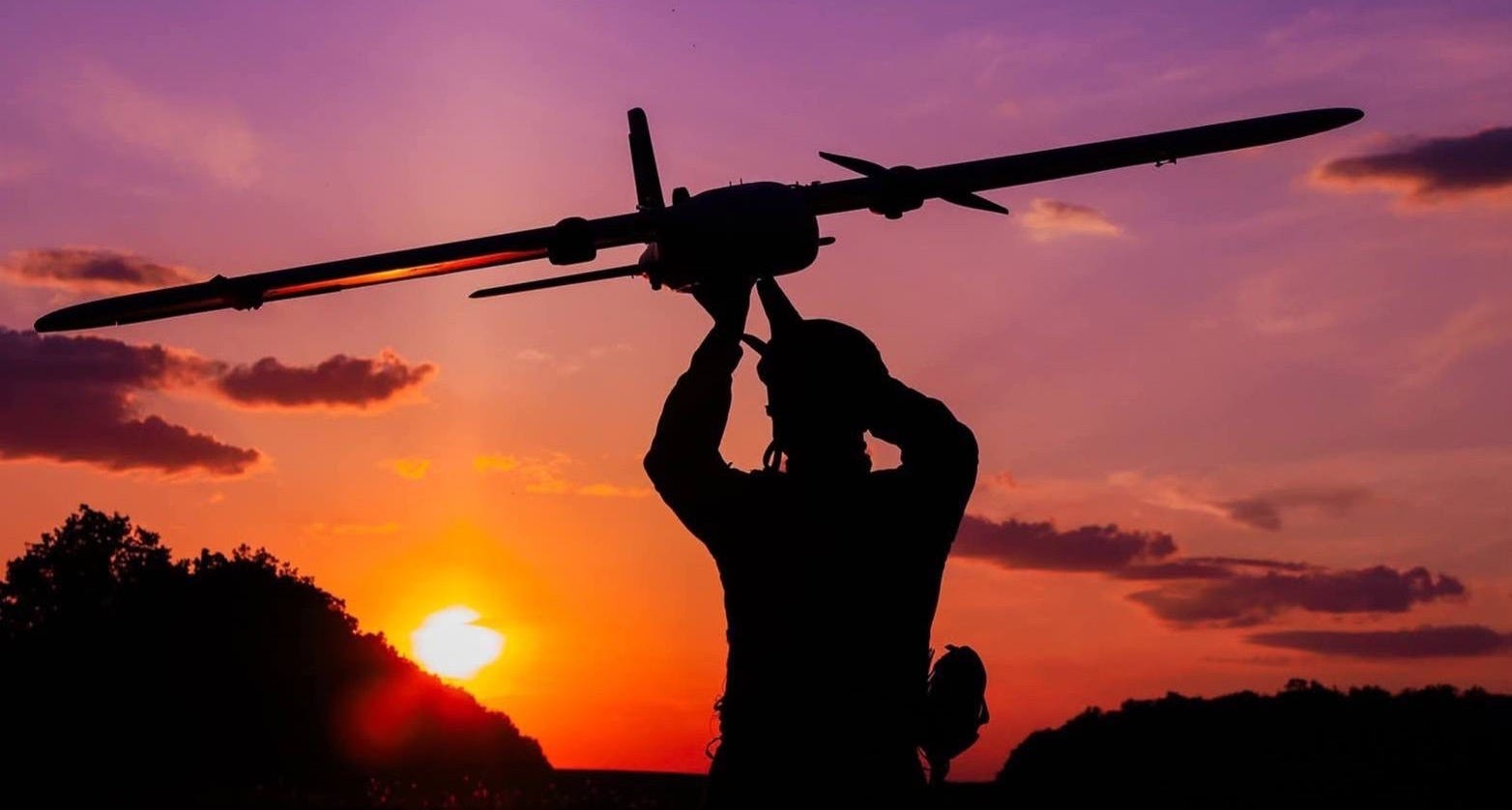
As the US-led peace initiative continues to falter, the unfolding summer campaigning season in Ukraine promises to be among the bloodiest of the entire war. In the coming months, Russia is hoping to build on more than a year of gradual advances to achieve breakthroughs on the eastern front, while Ukraine aims to demonstrate to the country’s partners that it is capable of stopping Putin’s war machine and holding the line. Mykola Bielieskov, 8 May 2025.
Welcome to this week’s edition of The Big Five.
In this edition of The Big Five, I explore issues concerning the war in Ukraine from the past week, as well as news from the Pacific region. As always, I have included my top five national security and war reads.
Ukraine
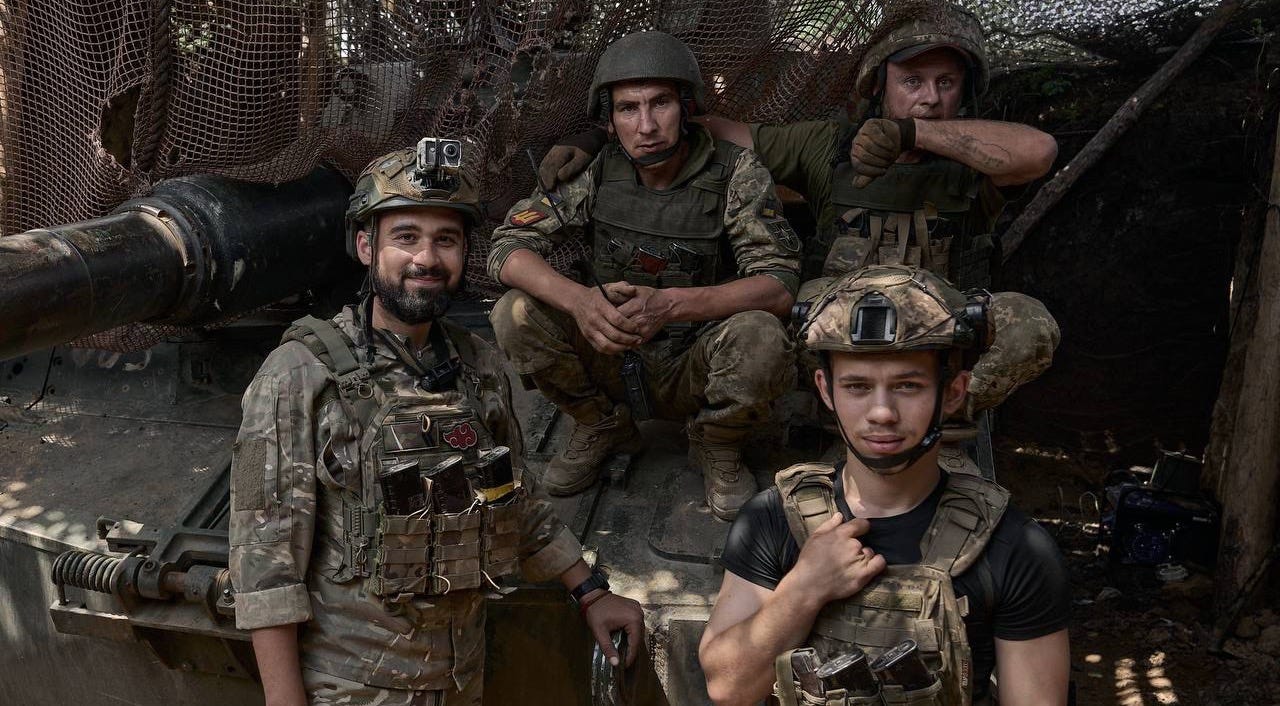
Ukraine’s New Government. In the past week, the Ukrainian president announced changes to the Ukrainian government. These changes can add new energy to a government. But, the reshuffle also appears to be aimed at improving Ukraine’s relationship with the Trump administration.
The new Prime Minister is Yulia Svyrydenko and the new Defence Minister is the former Prime Minister, Denys Shmyhal. As these new appointment were announced, the Ukrainian parliament also passed a law to merge the defence ministry and the ministry for strategic industries. Therefore, new Defence Minister Shmyhal will be in charge of the defence sector, domestic weapon production and international cooperation in weapons and defence.
Other new appointments in the government shuffle included:
Oleksii Sobolev, who will head the new ministry for economy, environment and agriculture, after these previously separate ministries were merged.
Taras Kachin, will be the Deputy Prime Minister for EU Integration.
Mykhailo Federov, who remains in charge of digital transformation, innovation, science and technology, moves up from Deputy PM to First Deputy PM as well.
President Zelenskyy also appointed former Defense Minister Rustem Umerov as Secretary of the National Security and Defense Council on July 18. Umerov’s new duties include coordination and control of the security and defence sector; coordination of arms deliveries, joint production efforts, and defence partnerships; and, peace negotiations.
President Zelenskyy, after appointing the new government, noted that:
I am counting on sufficient support from the Members of Parliament for the new configuration of the Government of Ukraine. It is also important that the Government promptly conducts an audit of all agreements with our partners to determine what is working and what requires reassessment or intensification.
More European sanctions. This week, the EU announced its next sanctions package against Russia, its 18th such package since February 2022. Key aspects of this new package include:
An oil cap to contain Russian oil prices at 15 percent of the average market price, which will automatically adjust semi-annually.
A full ban on any transactions related to the Nord Stream 1 and 2 pipelines, which will prevent the completion, maintenance, and operation of the pipelines.
A ban on all transactions with Russian financial institutions.
Sanctions on an additional 105 vessels of the Russian shadow fleet. Related to this was sanctions on Russian and foreign companies managing the shadow fleet, an oil refinery in India in which the Russians are the main shareholder, and a company in the Russian liquefied natural gas (LNG) sector.
The ending of Czechia's exemptions for Russian oil imports.
An import ban on refined petroleum products made from Russian crude oil and imported from any third country, with the exception of Canada, Norway, Switzerland, the United Kingdom, and the United States.
Russia’s Big Push. It is apparent that the Russians have decided that 2025 is to be the year of decision for their war against Ukraine. It is likely that the challenges of a straining national budget, declining quality of their ground forces, increasing reliance on North Korea & China to support their war and pressure from President Trump to end the war, are forcing the Russian president to step up operations on the ground and in the air against Ukraine. While he might publicly discuss being able to fight this war into the far future, the reality is far from the case.
Just one indication of this was Putin’s announcement at the end of June that military spending by Russia would be cut from 2026. Putin hopes that a major effort this year will put him in an advantageous position for negotiations. It is not working out this way for him.
On the ground, Russia has increased the overall seizure of territory in the past couple of months. It should be noted however that the ‘acceleration’ of capturing Ukrainian territory is measured against the largely anemic progress that Russia has made in the past 18 months or so. That said, the Ukrainian eastern front line is under considerable pressure from the Russians at present.
In June, Russia gained 550-600 square kilometres of Ukrainian territory, which was an increase compared to previous months. But, as can be seen from the graph below, these gains are not decisive in the overall scheme of the war. The Russian’s are not gaining enough territory to project any real sense of overall success.
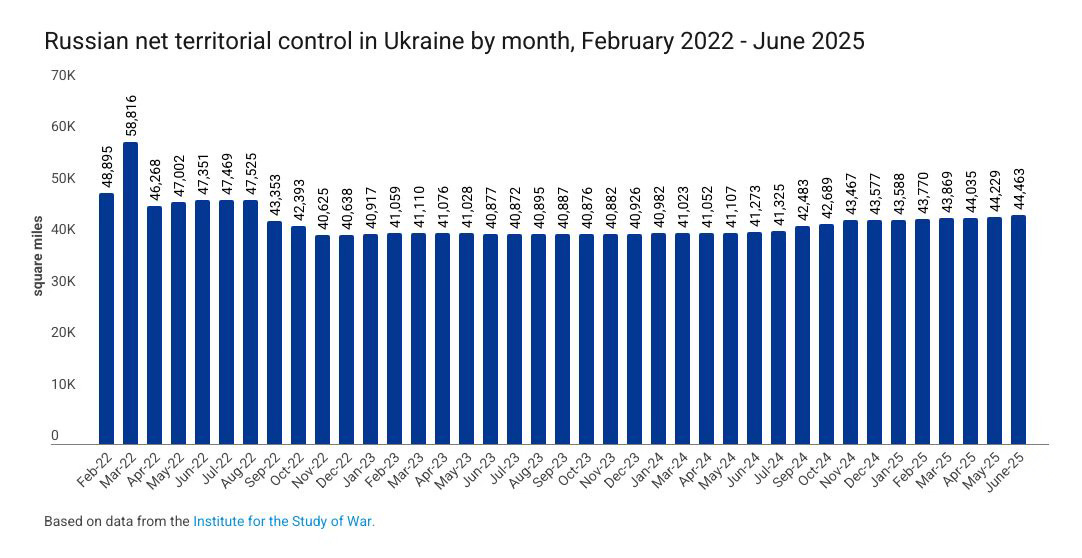
Too much analysis is focussed on the few kilometres Russia is gaining in the east, and not enough on why Putin might be going all out to make these gains now. He needs something to negotiate with when peace negotiations do begin, he needs to eventually reduce spending on the war, and he probably wants to reduce his overall reliance on North Korea and China. He is probably under far more pressure than we realise.
But it is also clear that Putin still believes he can will this war. Until he can be disabused on this notion, the Russians will continue with their current ‘big push’.
In the air, Russia continues to pummel Ukraine with large-scale drone and missile raids. The latest series of raids occurred 16-19 July. Beginning with a 401 drone and missile raid on the 16th, Russian then conducted two nights of smaller raids on the 17th (64 drones) and 18th (35 drones) before returning to another large raid of 379 drones and missiles on the night of the 19th of July. While a large proportion of these were shot down, enough are still getting through Ukraine’s air defence network to cause damage, and increase the suffering and misery of Ukrainian people in many cities.
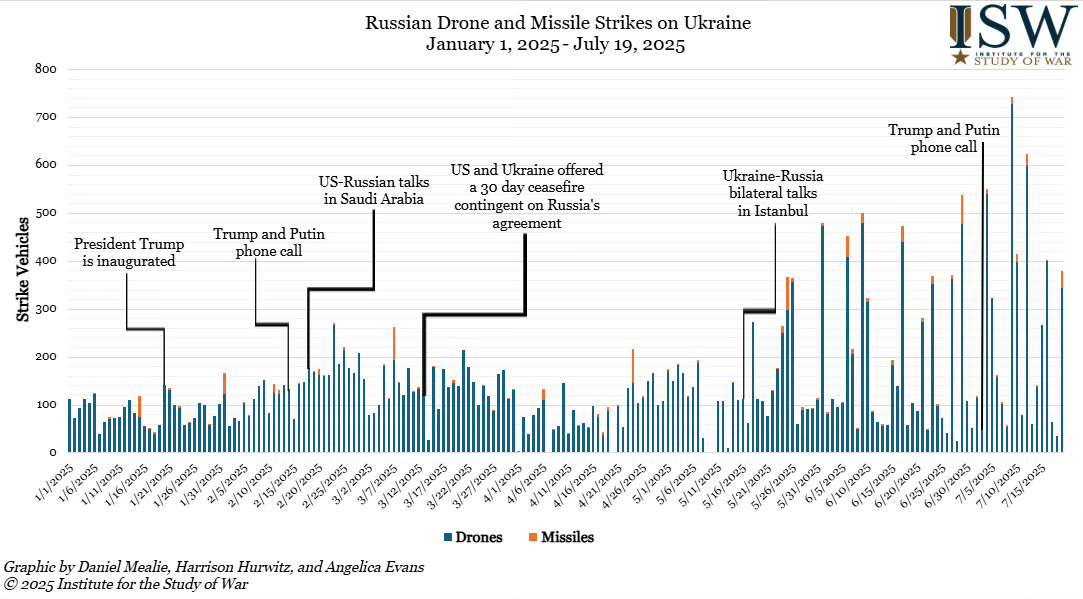
While Russia is able to generate large aerial attacks against Ukraine, and is increasing the production of Shahed/Geran-2 drones, this expanded aerial onslaught may prove strategically counterproductive for Russia and drive up the level of foreign military aid for Ukraine. Russia’s enlarged air campaign against Ukrainian civilians (see graph above) was clearly a driver in Trump’s recent decision to step up provision of air defence systems and issue his 50-day ultimatum to Putin.
Despite this step up in their air-land assault, it is unlikely that this Russian air-land push will result in a major shift in the correlation of forces, or provide either side with any significant new leverage points for eventual peace negotiations. While Ukraine is suffering from a manpower shortage, it appears still able to impose significant personnel costs on the Russians and deny them the capacity for large-scale breakthroughs. Ukrainian efforts to construct multiple defensive lines in eastern Ukraine are bearing fruit, and the Russian offensive in the Sumy region appears to have be largely halted by the Ukrainians.
Russia’s main effort remains the region around Pokrovsk. Here the Russians are making gains, but these gains are taking time to achieve and are still resulting in major casualties.
This overall situation with the air and ground campaigns in Ukraine is neatly summarised by @Tatarigami in a recent assessment:
Fundamentally, both Russia and Ukraine face organizational challenges, though of different kinds. Ukraine suffers from delayed mobilization and delayed structural adaptations, while Russia struggles to translate its vast resource advantage into a combined and coordinated force

Ukrainian Military Force Structure. Ukraine’s program to replace temporary ground force organisations with standing army corps continues. Multiple new corps have been formed over the last few months, and brigades have been assigned to these corps. There has also been a steady flow of appointments of new corps commanders. A great source for following force structure changes of the Ukrainian military is MilitaryLand, which you can see at this link.
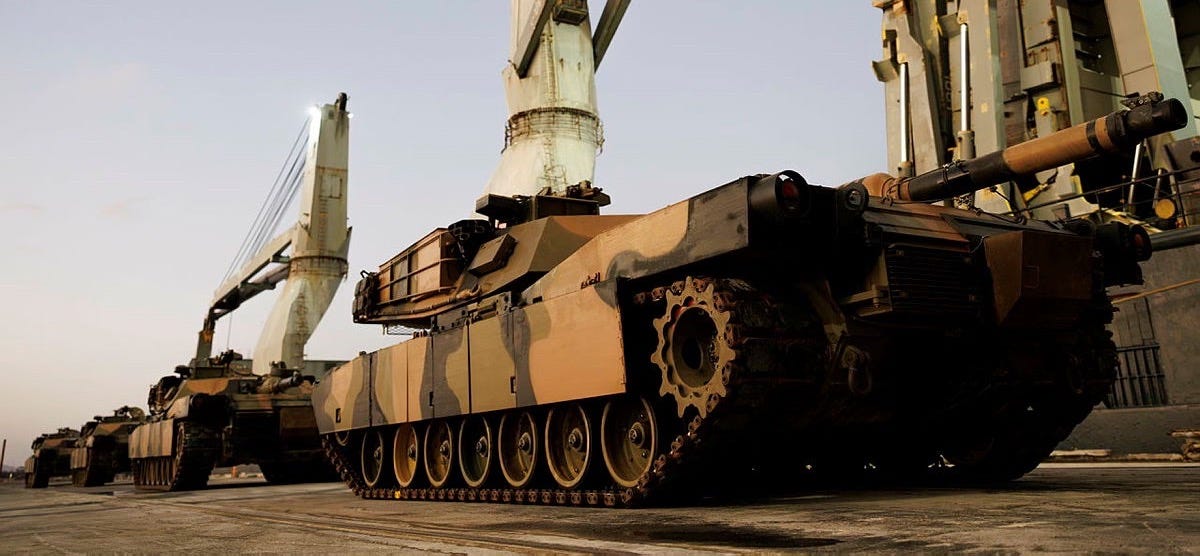
Australian M1 Tanks Arrive - Finally. It appears that the first of Australia’s donated M1 tanks have finally started to arrive in Ukraine. It took nine months for these to arrive while Ukrainians fight for to defend their nation. One hopes that Australia’s defence bureaucrats can do better if Australia was in the middle of its own war of national survival.
The Pacific
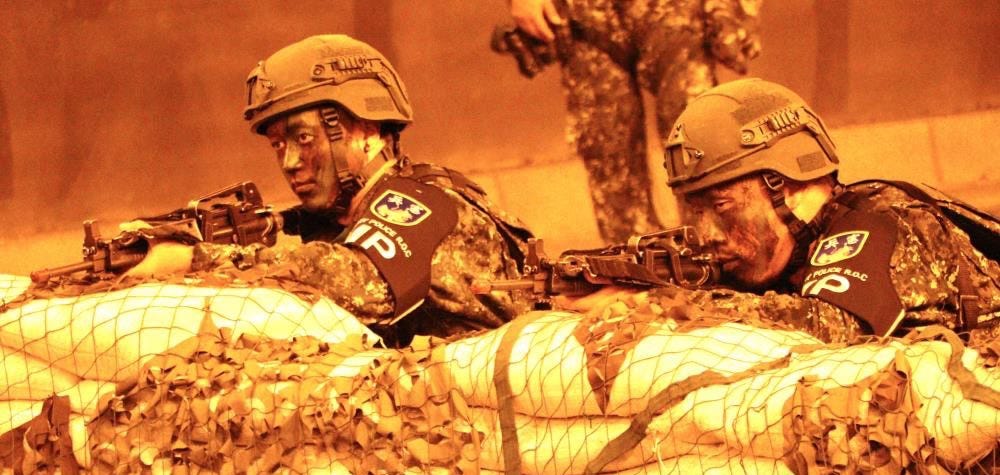
Exercise Han Kuang 2025. This week, Taiwan wrapped up its major annual military exercise. Conducted across the length and breadth of Taiwanese territory, the exercise rehearsed a range of military and civil capabilities that might be needed to respond to increased Chinese military aggression, or at worse, a Chinese invasion of Taiwan. Key military capabilities rehearsed over the course of the exercise included the following:
The mobilisation of reserve troops, such as the 6th Army Corps, 104th and 302nd Brigades, and employment of those troops.
Live fire drills.
Amphibious and urban operations.
Deployment of dispersed anti-ship missile units.
Integration of uncrewed systems.
Aerial and naval drills including air defence, runway repair and mine laying exercises.
Night fighting activities.
Subterranean operations in Taiwan’s subway.
The emplacement of coastal fortifications and obstacles by military engineers and anti-landing and anti-airborne exercises.
Civil air raid drills.
A useful breakdown of all the activities is shown in the graphic below, courtesy of the Taiwan Security Monitor.
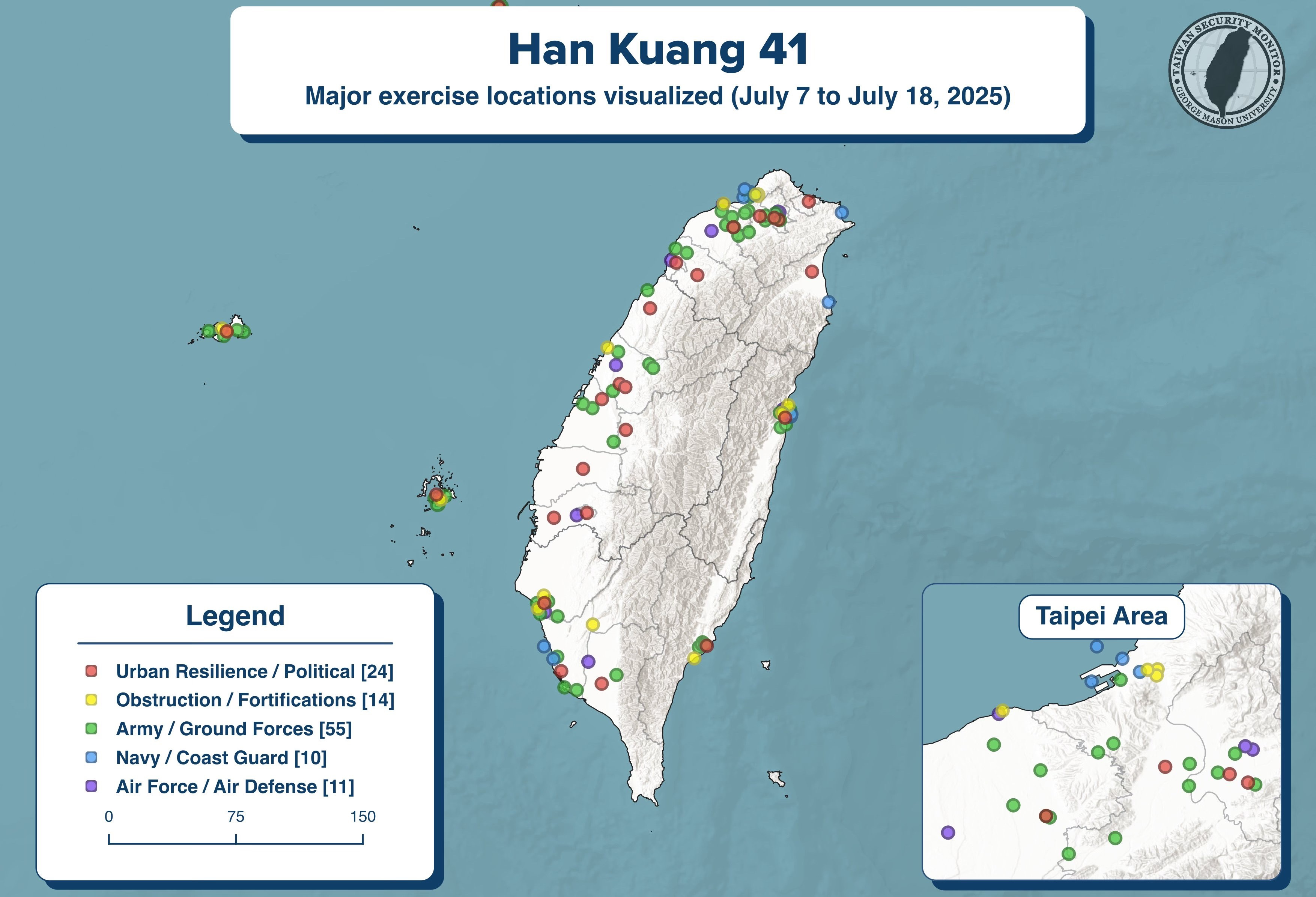
This year’s Han Kuang was the largest and most comprehensive exercise held to date. Integrating civil and military operations, and including high level joint activities and the conduct of counter-landing, counter-airborne, air defence, anti-maritime and counter-drone operations, it is an indication of Taiwan’s ongoing modernisation of its military strategy for defending the nation in the event of a Chinese invasion.
One interesting thing to note about this event is that it is a unilateral military exercise. There is no overt participation by nations that might be key supporters of Taiwan in the event of a Chinese campaign to seize the nation of Taiwan. The most likely supporters, America and Japan, were absent from this exercise. This is an issue taken up in an article published by National Defense, which you can read here.
This approach stands in stark contrast to the other major military exercise currently underway in the Pacific region: Exercise Talisman Sabre 2025.
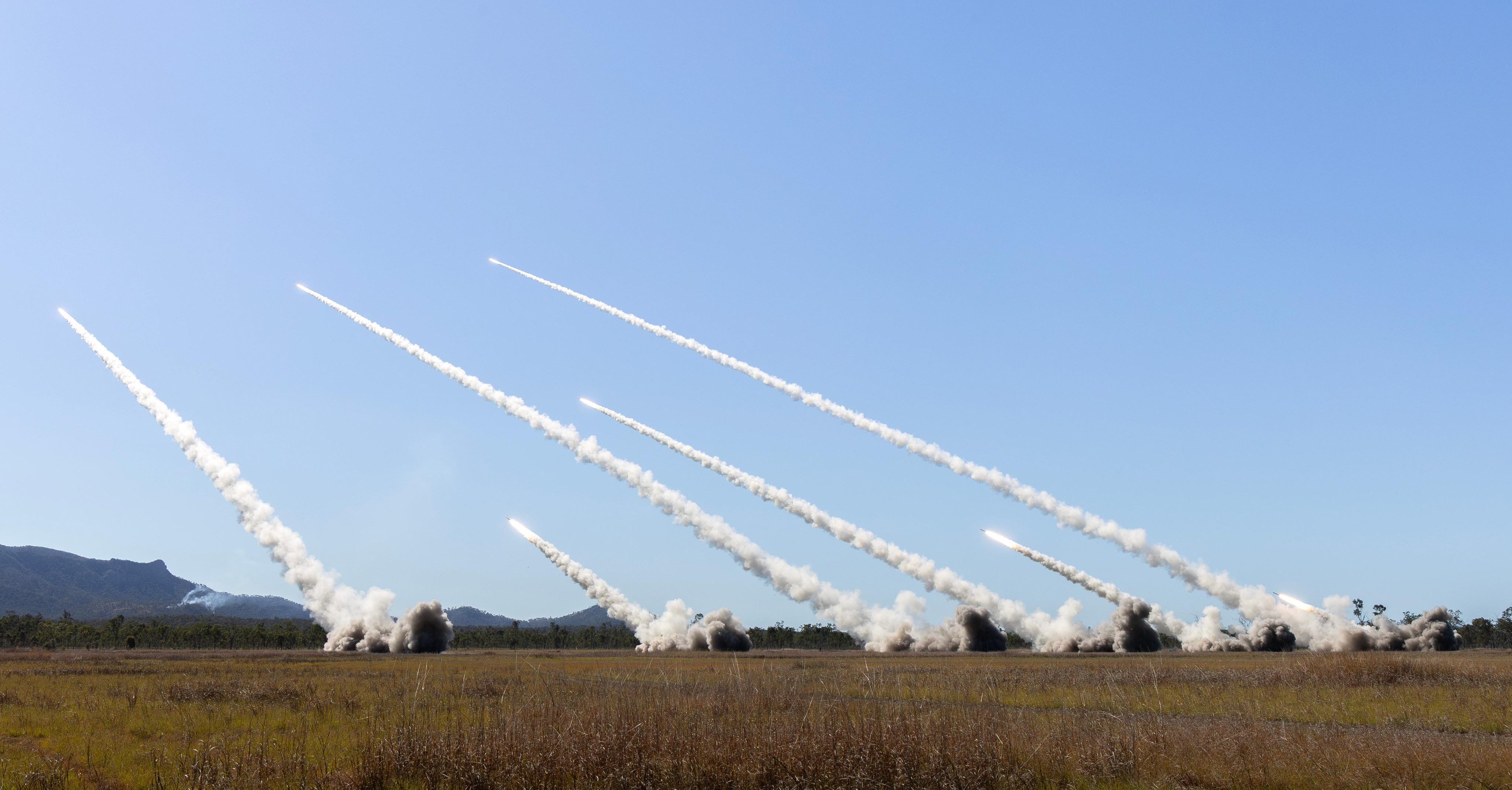
Exercise Talisman Sabre 2025. This major multinational exercise, with 19 nations and 40,000 personnel participating, began on 14 July and is currently taking place along the east coast of Australia as well as across northern Australia. Featuring large scale joint operations, Talisman Sabre tests the integration of joint and combined forces from across the Pacific region, as well as smaller contributions from European countries.
The exercise has also featured live fire activities. This includes the live fire exercise with multiple nations (see image above) as well as the first live fire of the Australian Army’s new National Advanced Surface to Air Missile System (NASAMS).
There are also a lot of operations that are not immediately visible to outside observers. These include space and cyber operations.
Another vital element of the exercise is the supporting logistics. Deploying military forces is a logistic intensive activity, and the ‘loggies’ from multiple nations work hard in the lead up to, during and after these major exercises to make them happen.
Importantly, testing and rehearsing higher level command and control will be a crucial aspect of Talisman Sabre. While we still call these events ‘exercises’, in many respects they are now closer to ‘rehearsals’ for the kinds of response options that the U.S., its allies and security partners might be called upon to execute in the event of accelerated Chinese military aggression - including an invasion of Taiwan - in the coming years.
Having participated in a couple of these exercises, I believe they are not only extraordinarily important but they are also one of the best learning opportunities our service personnel receive. I wish all the participants a successful and safe conduct of Exercise Talisman Sabre 2025.
*******
It’s time to cover this week’s recommended readings.
I have included a new article from Foreign Affairs that examines whether China is ready for a military invasion of Taiwan, and the new annual Defence of Japan publication which is always a great resource. There is an article on Finnish conscription and national mobilisation, as well as articles on Ukraine’s evolving drone industry and the lessons from Israel’s air war over Iran.
As always, if you only have time to read one of my recommendations, the first one is my read of the week.
Happy reading!
1. Is China Ready for War?
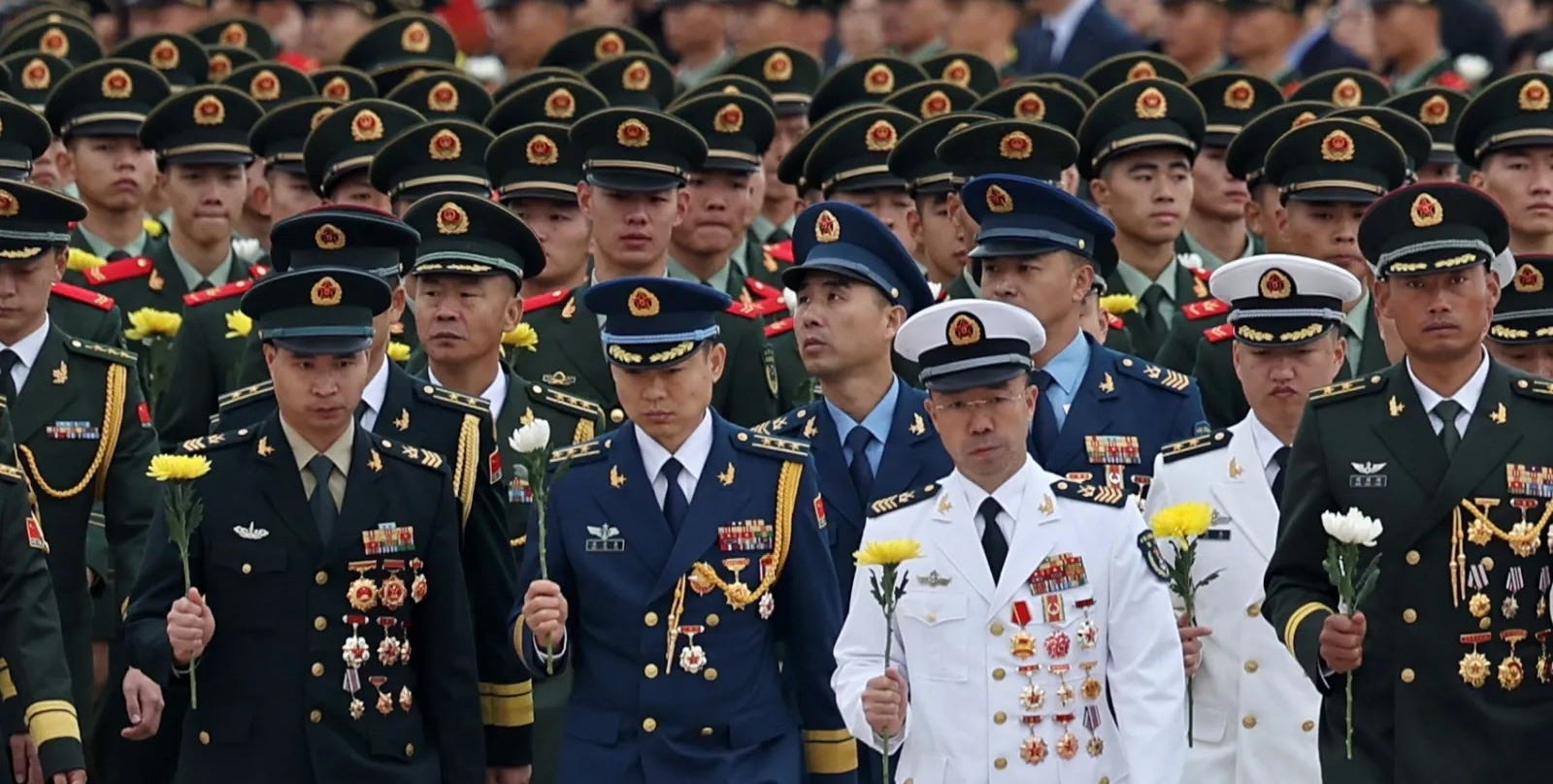
The year 2027 is a crucial one in discussions about potential Chinese military operations against Taiwan. President Xi has given 2027 as a capability milestone (not an operational objective) for the PLA to be ready to seize Taiwan by force if necessary. As such, explorations of Chinese readiness to achieve this milestone are important in guiding the diplomacy, intelligence collection, force structure and military readiness of Pacific nation. In this article, the authors explore Chinese military readiness through the lens of senior leader purges and appointments. You can read the full piece here.
2. Ukraine’s Drone Industrial Complex
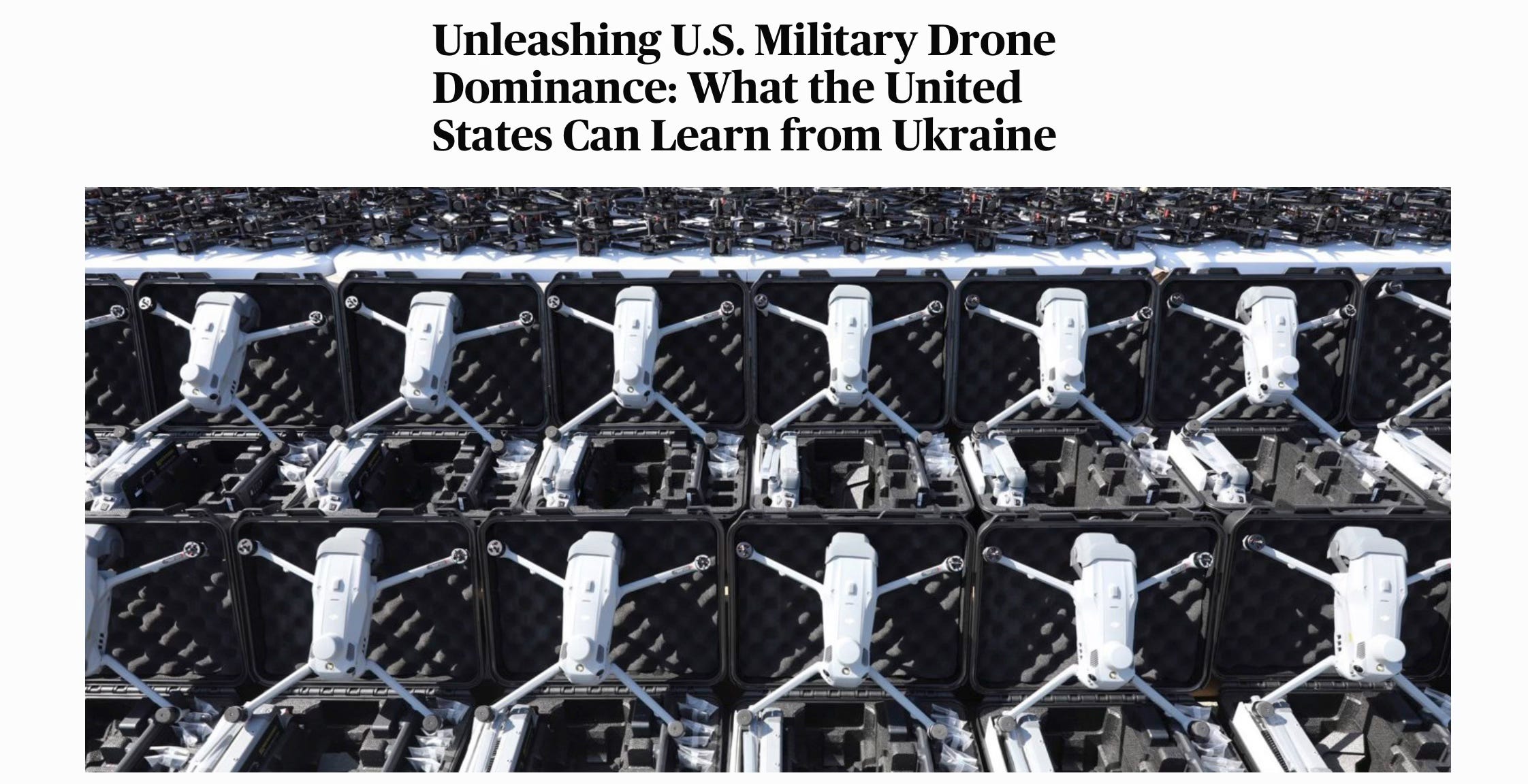
The development of a modern drone industrial complex in Ukraine has been crucial to Ukraine’s survival as a nation. Ukraine has transformed military affairs with its early adoption of large-scale drone operations in the air, at sea, and more recently on the ground, in defending itself. In this report, the development of Ukraine’s employment of drones, and how it as evolved its procurement of drones to exploit rapid learning and adaptation about drone technology and tactics, is explored in this article. It also proposes lessons for other nations. You can read the article here.
3. The New Defence of Japan Paper
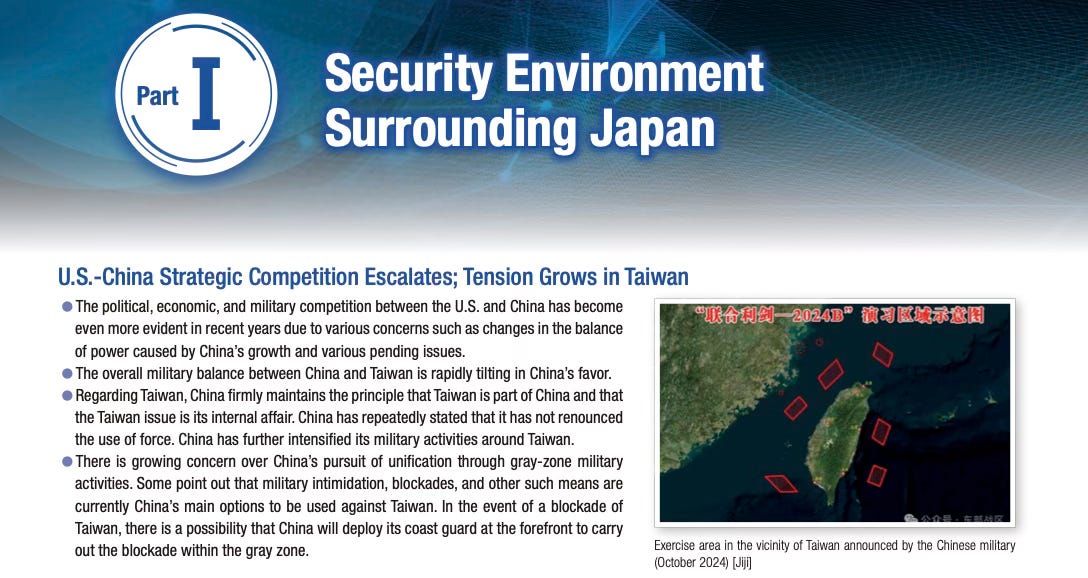
The annual issue of the Defence of Japan document is something I look forward to. It is one of the best defence documents released by any military in the world. The Defence of Japan publications provide very clear explanations of the threats that concern the government of Japan and which its military forces are preparing for. They have also provided good assessments of lessons from Ukraine and the Middle East, and have a relatively transparent description of where the Japanese defence budget is being spent. You can read this excellent document at this link.
4. The Air War Over Iran

Israel’s recent take down Iran’s air defence network with sophisticated 5th generation aircraft, supported by older F16, F15 and tanker aircraft, shows that the future of war in the air is not just about uncrewed aerial warfare. The Israeli’s showed why a balance of crewed and unscrewed systems is essential, particularly as a key enabler to getting their crewed aircraft over Iran was the initial strikes on Iran’s air defence system with small UAVs. You can read the full article at this link.
5. Finland’s Conscription Lessons
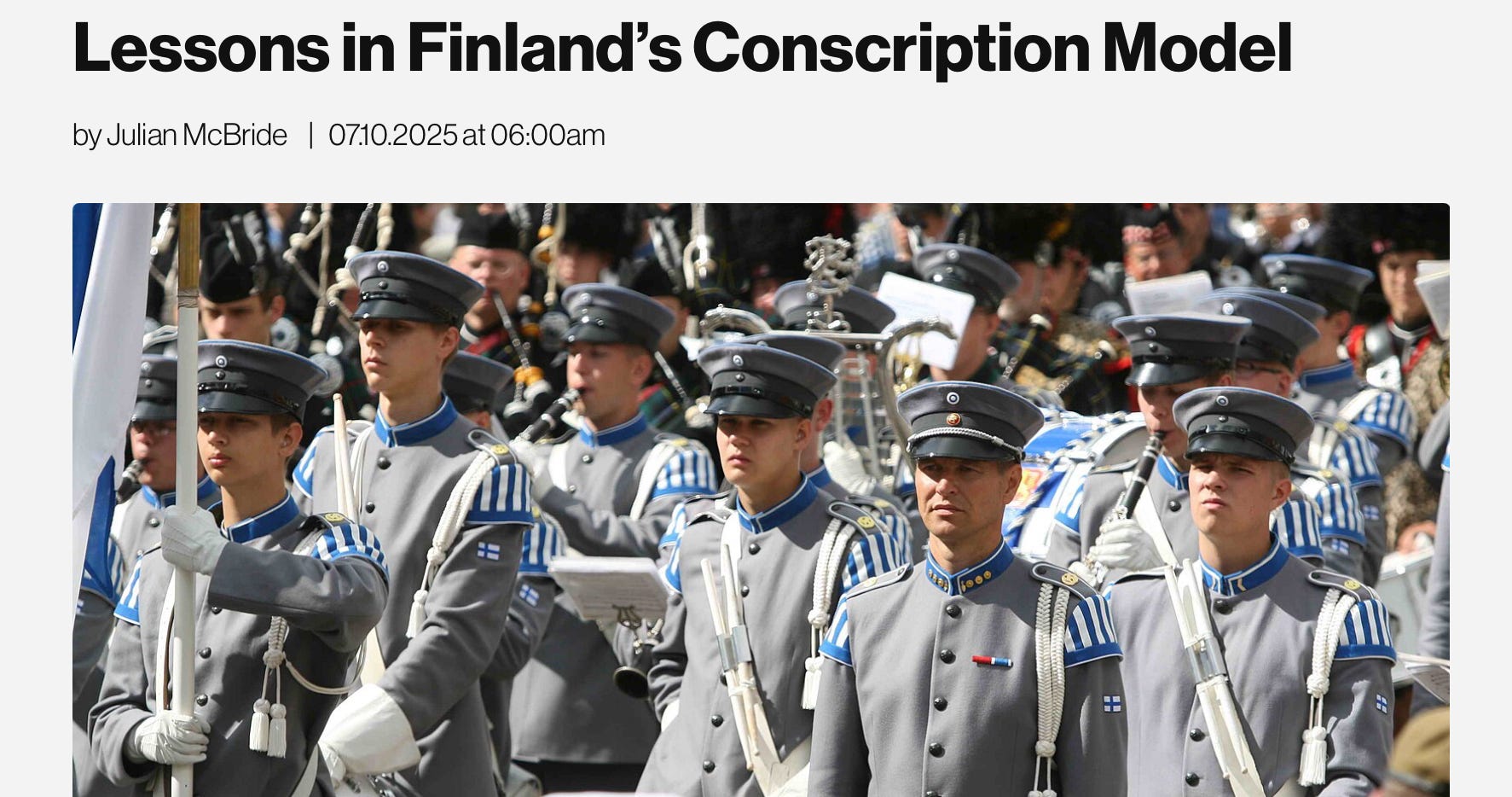
It is no secret that the all-volunteer models of many western military organisations are starting to show vulnerabilities. Recruiting sufficient numbers to fill the ranks is difficult. And even if the ranks were filled, our military organisations are still too small for the scale of likely future conflicts. To that end, a re-examination of conscription is needed. There are several models in existence from which we might learn, including the Finland model, which is explored in this article. You can read for the full piece at this link.
Thank you for the article recommendations. I’ve seen the headline of the Foreign Affairs article, but did not realise the depth it has; it was a really good read, even if short. And the Japan defence article is on my reading list indeed.
The next ten years, and then all the way to 2050, are full of danger for the Asia Pacific region…
One problem with basing our drone procurement methodology on Ukraine is that we have no battlefield on which to test them. We can imagine what the enemy would throw at us, but that's just a hypothetical. To prepare American companies to operate in a in a Ukraine-like environment, where products are evolving and step with the enemy and battlefield needs, maybe we need to send a bunch of engineers over there to participate directly in the Ukrainian market.
otherwise, we should be buying the latest and greatest from Ukraine directly.