
The Venezuela Raid
Operation Absolute Resolve has global implications. Some thoughts on the mission, and a special focus on the implications for Australia.

We want to ensure that the Western Hemisphere remains reasonably stable and well-governed enough to prevent and discourage mass migration to the United States; we want a Hemisphere whose governments cooperate with us against narco-terrorists, cartels, and other transnational criminal organizations; we want a Hemisphere that remains free of hostile foreign incursion or ownership of key assets, and that supports critical supply chains; and we want to ensure our continued access to key strategic locations. U.S. National Security Strategy, 2025.
It has been a fascinating 48 hours. As the national security advisors from multiple nations gathered in Kyiv in the wake of a major Ukrainian government shake up, and discussed issues such as security guarantees and reconstruction, the United States government launched a lightening raid in Venezuela to capture the president of that country.
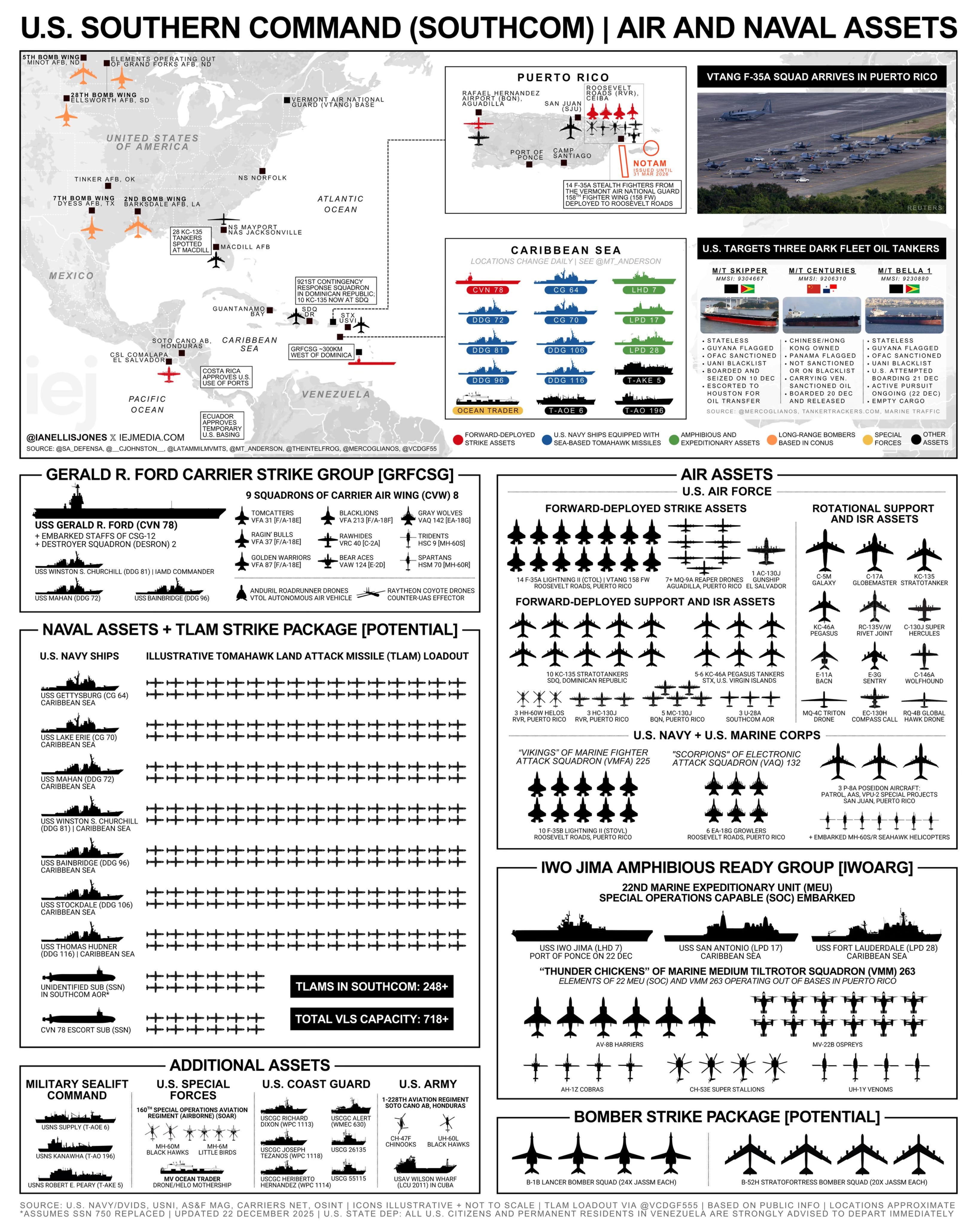
It followed a multi-month build up of U.S. military forces in the region. As the chart below produced by Ian Ellis Jones shows, the Trump administration had the forces in place for a range of different activities against the Maduro government. In the end, it chose to conduct a short, limited objectives mission focused on the capture of the Venezuelan president.
In many respects, the raid hewed to the tactics and procedures honed over two decades of U.S. Special Operations in places like Iraq, Afghanistan and elsewhere. But as an article at the excellent High Side substack describes:
A bold nighttime raid in Caracas executed by Delta Force and the 160th Special Operations Aviation Regiment with an air package overhead totaling more than 150 aircraft captured Venezuelan President Nicolas Maduro and his wife Cilia Flores last night. The mission, called Operation Absolute Resolve, was not a typical JSOC capture/kill raid but rather was designed to serve an arrest warrant based on a Department of Justice indictment against Maduro and his regime. In this sense, the Delta operators were escorts to federal law enforcement officers.
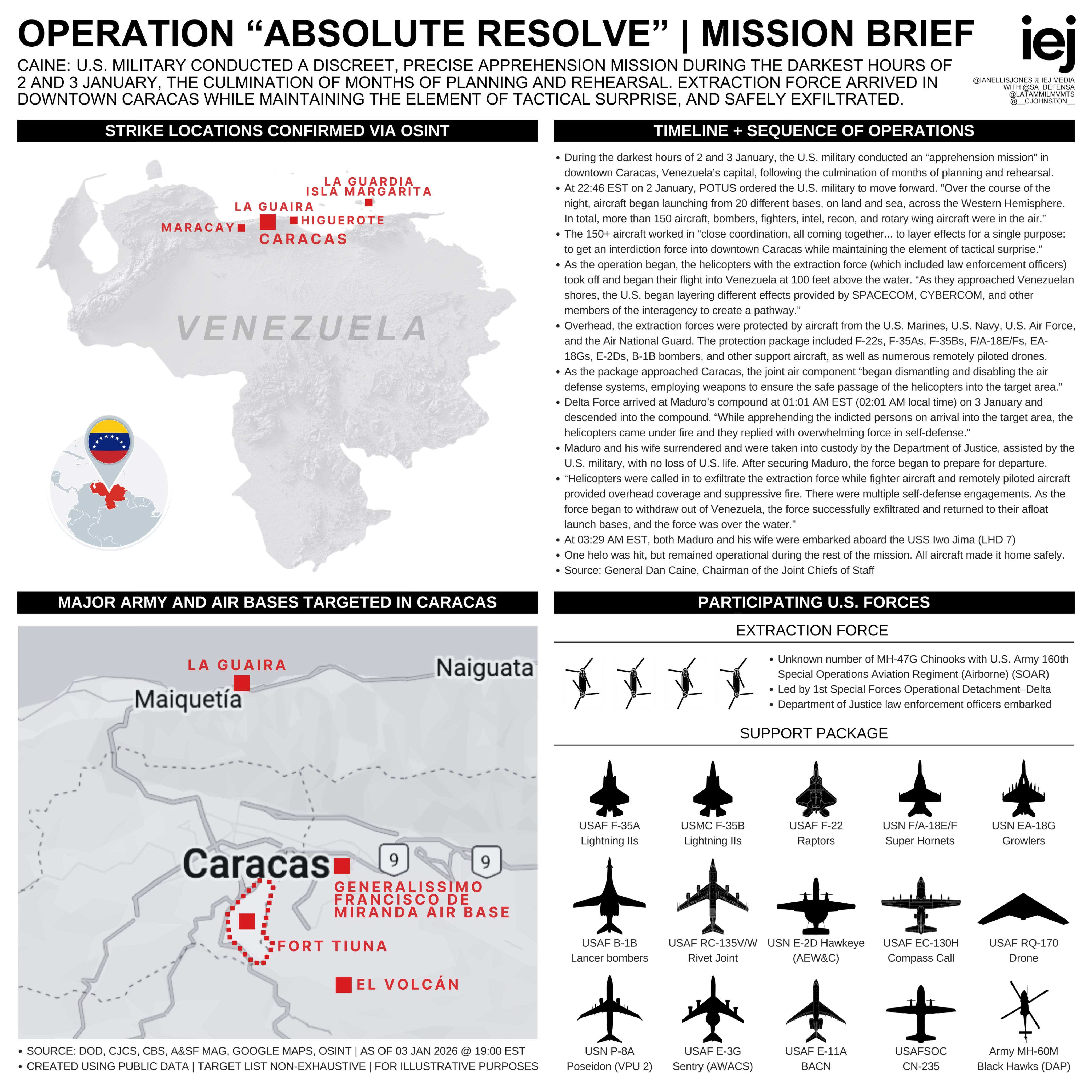
The raid appears to have gone, from an American perspective, relatively to plan. No U.S. service personnel were killed but there were some who received minor wounds. Reports from Venezuela indicate around 40 people on the ground there may have been killed, but we should wait for official confirmation of that. The chart below is a representation of the the conduct of Operation Absolute Resolve and the military assets employed in its execution.
The debrief conducted by President Trump provided the following information:
The mission had a narrow scope - capture the Venezuelan president. (His wife is apparently accompanying him on his ‘visit’ to America).
A second phase of the operation had been planned but was currently in abeyance.
President Maduro had been initially taken to the USS Iwo Jima and then transferred by aircraft to the United States.
The United States would ‘temporarily run’ Venezuela.
On the ‘run Venezuela’ task, President Trump’s exact words were:
We’re going to run the country until such time as we can do a safe, proper and judicious transition. We don’t want to be involved with having someone else get in, and we have the same situation that we had for the last long period of years. So we are going to run the country.
What that looks like, the key objectives and duration were not clear. Trump did add that “we’re going to stay until such time as the proper transition can take place.” And, he described how America would assume control of Venezuela’s oil reserves. It would also enlist American companies to invest in Venezuela’s oil industry to refurbish it’s oil industry.
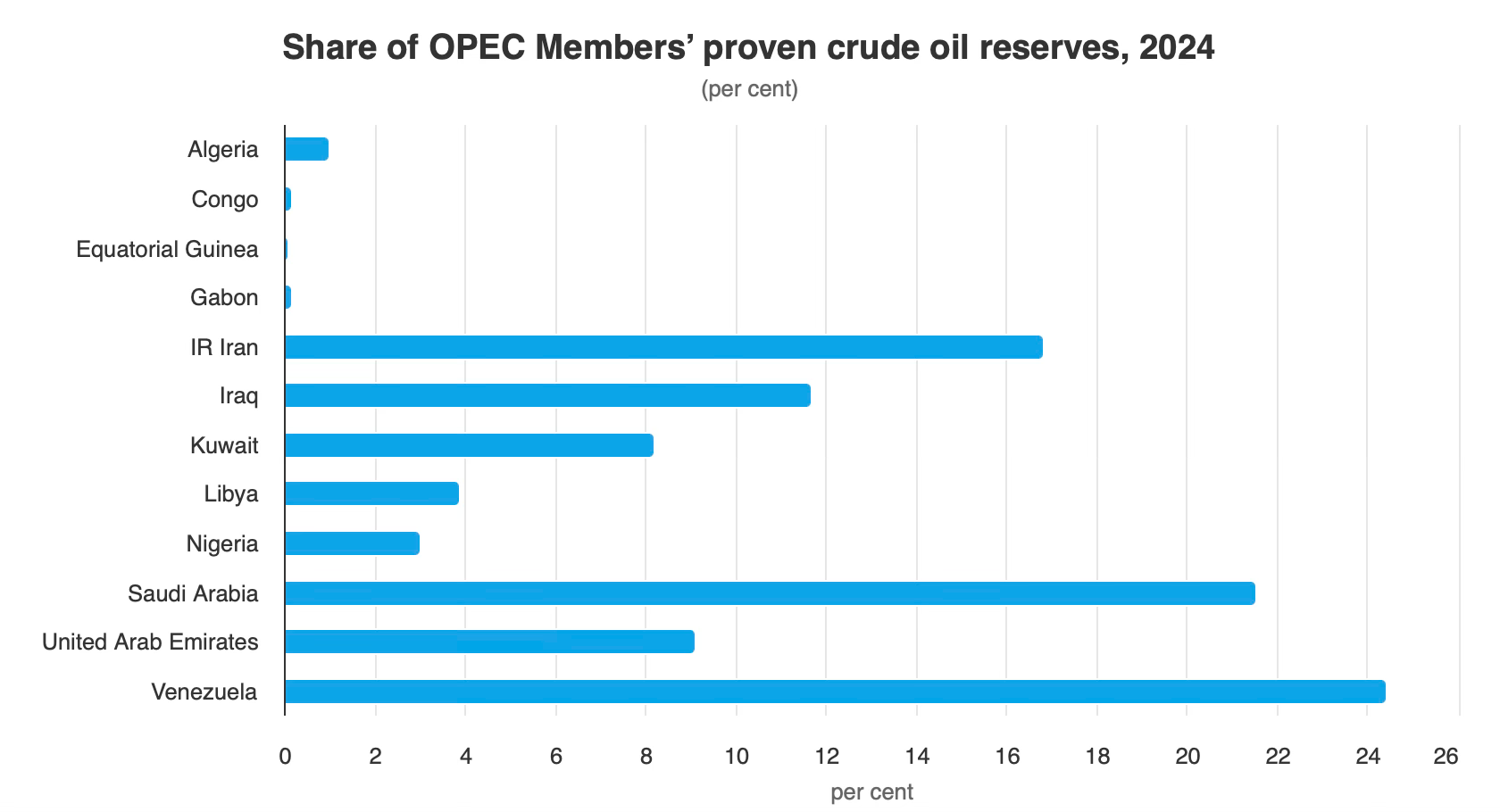
As the 2024 OPEC chart below shows, Venezuela has a lot of oil:
On this issue, President Trump was quoted as follows:
We’re going to have our very large United States oil companies — the biggest anywhere in the world — go in, spend billions of dollars, fix the badly broken infrastructure, the oil infrastructure.
On a separate issue, over the weekend, the American government also unsealed an indictment against Venezuela’s president. A four-count indictment also charges Mr. Maduro’s wife, his son, high-ranking Venezuelan officials and an alleged leader of a drug smuggling gang.
In the wake of the two-hour and twenty-minute raid, an expanding number of articles are exploring the military execution of the raid (including stealthy drones, special and conventional forces), the intelligence preparation beforehand (including the key role played by CIA agents on the ground), and the legal basis (or the potential lack of) for the operation.
Other topics likely to be explored in the coming days will include spheres of influence, American strategic priorities, and the myriad of other strategic implications arising from the Venezuela raid and the removal of a man who was a brutal, corrupt socialist dictator.
As we learn more in the coming days, the number of analyses and commentaries will continue to proliferate.
Unsurprisingly, both China and Russia have offered their own commentaries on the raid. As expected, they have condemned it. But secretly, Russia will be green with envy given it has launched multiple efforts to murder President Zelenskyy in the past few years and failed. And, given this is the third country (after Syria and Iran) that Russia recently pledged support for, and failed to deliver, hopefully other nations looking to Russia for support - and their hopeless military equipment - will think again.
China, secretly, will be studying the raid for lessons to inform its future actions against Taiwan or other nations in the western Pacific. They don’t state that of course. You can read the official statement from China’s Foreign Ministry at this link.
American academic and author Tom Nichols has offered a perspective this morning on the ‘outrage’ demonstrated by the big authoritarians. As Tom notes:
Hypocrisy, the French nobleman François de La Rochefoucauld once said, is the tribute vice pays to virtue. In this case, there is little virtue to be found; the Russian and Chinese statements are vice paying tribute to vice. They already know that the president of the United States is helping to clear the way for their adventures—and they should keep their faux outrage to themselves.
*******
This morning, I wanted to explore a perspective of the raid that most in the northern hemisphere will either not be interested in, or unaware of. That is, what are the implications of the raid for Australia?
Just because we live at the bottom of the world, and many of our politicians are relatively complacent about national security (and who still refuse to spend more than just over 2% of GDP on defence), that does not mean the Venezuela raid has no lessons for us. It does. Therefore, below I have posted my article from the Lowy Interpreter on this topic, which was published just a short time ago.
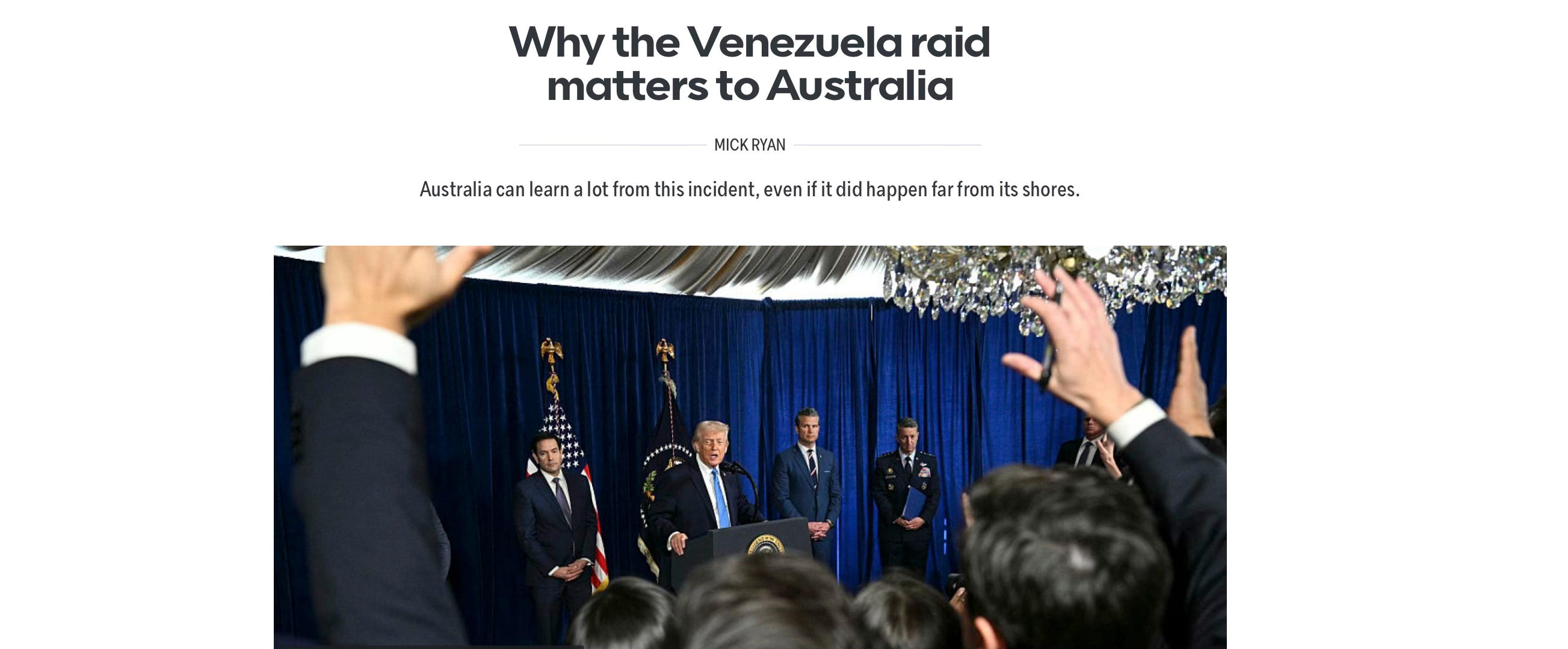
There will be a tendency in Australia to write off the American night raid to capture Venezuelan President Nicholas Maduro as an isolated incident in South America with little local relevance. A combination of geographic distance, a focus on our immediate region, domestic concerns and a deep complacency about national security conspire together to lead Australians to this conclusion.
That would be a mistake.
As the new year breaks, the team assembling the 2026 edition of Australia’s National Defence Strategy will be closing in on their final drafts and circulating them for comment among senior military, public service and political leaders. A key area of deliberation will be the future of the US alliance and what the the Trump administration means for force structure, AUKUS, infrastructure to support American forces, and the overall budget.
While discussions with our American partners will provide vital input into Australia’s National Defence Strategy, so too will the recently released US National Security Strategy. The Venezuela raid provides an insight into the Trump administration’s implementation of the Strategy because this operation hews to the priorities listed in it.
The Trump strategy places America’s western hemisphere first among its priorities. While heavily biased towards economic initiatives, the document also focuses on pushing back foreign influence. It notes that “non-Hemispheric competitors have made major inroads into our Hemisphere, both to disadvantage us economically in the present, and in ways that may harm us strategically in the future.”
Viewed through this lens, the Venezuela raid assumes a different meaning from the law enforcement operation that the US president described in his 3 January press conference. The Americans were asserting their primacy in the region, in the capital of a nation that had supported Russia’s operations in Ukraine and which had just completed meetings with senior Chinese diplomats hours before the raid commenced.
Unfortunately, the American demonstration of abiding by the priorities of the National Security Strategy could also be interpreted as the Trump administration being open to a “spheres of influence” approach to foreign policy. This has been the subject of much speculation in the past year. As a series of articles in Foreign Policy magazine argued:
the spheres-of-influence approach to grand strategy largely fell out of public discourse at the end of the Cold War, a time of great hope for globalization and multilateralism. But now, many analysts argue that under the second Trump administration—not to mention the regimes of Russian President Vladimir Putin and Chinese President Xi Jinping—it is back with a vengeance.
Australia is in tough position in such a world. Into whose sphere of influence does it fall, and does it get a choice? The NSS lists Asia listed as a priority for American security, and the US is reinvesting in its Asian alliances with Japan, Korea, the Philippines and Australia. But will America compete for, or cede to China, a sphere of influence in Asia? Sorting through the ramifications, and Australia’s security relationship with its key military ally, will be challenging for the authors of the National Defence Strategy.
Two other aspects of the raid will interest Australian strategists.
You can read the full article, for free, at this link.
I hope that the Australian Strategic Review will settle on the realisation we can no longer depend on the USA. We need an Echidna/Porcupine defensive strategy that does not depend on unreliable allies
As noted before by others, Venezuela has a government, a Constitution, and a Vice President, who has now become its President. Maduro has been replaced, but the Venezuelan national government still appears to be largely intact. Evidence that the US will be able to run Venezuela appears to have some minor logical omissions.