
Ukraine’s New Military Command Team
My new piece for the Lowy Institute on the changes in military leadership in Ukraine.

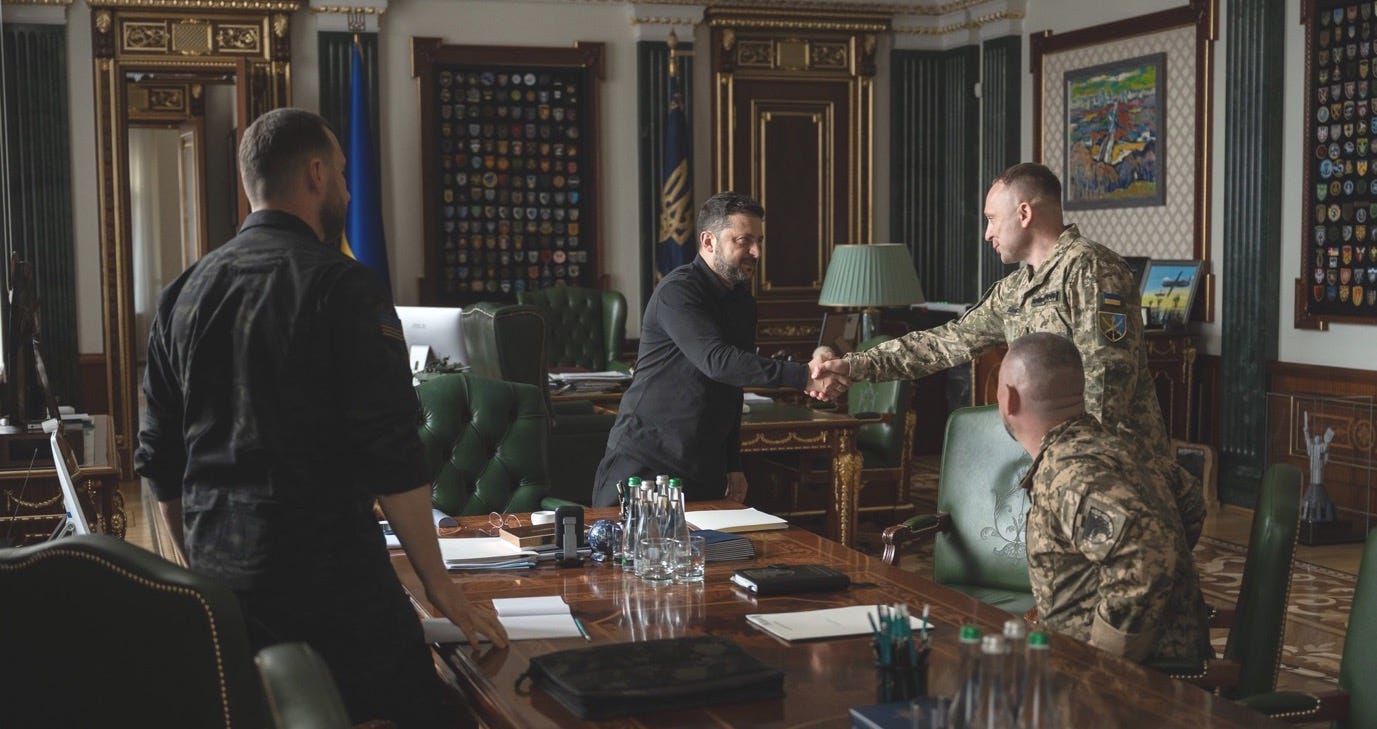
Congratulations to Major General Mykhailo Drapatyi on his appointment as Commander-in-Chief of the Armed Forces of Ukraine. This is a breath of fresh air and a new source of hope in the fight of free people for freedom and justice. It is the voice of change that could no longer be ignored. Mykhailo Fedorov, 22 July.
President Volodymyr Zelenskyy has again reshaped the top of Ukraine’s war effort. On 21 July, after six days of protests, he dismissed General Oleksandr Syrskyi as Commander-in-Chief and appointed Major General Mykhailo Drapatyi in his place.
The change followed the earlier removal of Defence Minister Mykhailo Fedorov, whose sacking set off the demonstrations and exposed a civil-military crisis within Ukraine’s government and military establishment. Fedorov has been offered a role overseeing defence technology, an acting minister, Yevhenii Khmara, is in place, and rallies on the street demand Fedorov’s return.
However this is resolved, Ukraine now has a new military command team. It has a leadership pair whose fortunes are joined. Neither can win the war alone, and neither can afford to work against the other.
Ukraine’s recent history shows how quickly civil-military relationships can break down. Since February 2022, civil-military relations at the top have at times been fraught. General Valerii Zaluzhnyi fell out with Zelenskyy over strategy, the failed 2023 counteroffensive and mobilisation, and was moved to London as ambassador in early 2024. Syrskyi, who replaced him, drew steady criticism for his top-down, Soviet-style command culture. Both previous commanders-in-chief had problems dealing with the civilian defence minister and bureaucrats.
When Fedorov arrived with a reform agenda built on data exploitation, digitisation of command and control, drones and cleaner procurement, he and Syrskyi clashed so badly that, by Zelenskyy’s own account, they would only cooperate when the president stepped in to mediate. That is not a command team. It is two centres of power pulling in different directions while hundreds of thousands of soldiers fought to prevent Russia extinguishing Ukraine.
Drapatyi and his new ministerial partner have a chance to break this pattern. Since he first rose to prominence in 2014, Drapatyi has built a reputation as a modern, soldier-focused commander who seeks input from his subordinates, supports innovation – including the initial development of Ukraine’s drone line – and accepts responsibility when things go wrong. He resigned as Ground Forces commander in 2025 after Russian strikes killed troops at a training ground, a rare act of accountability in any army.
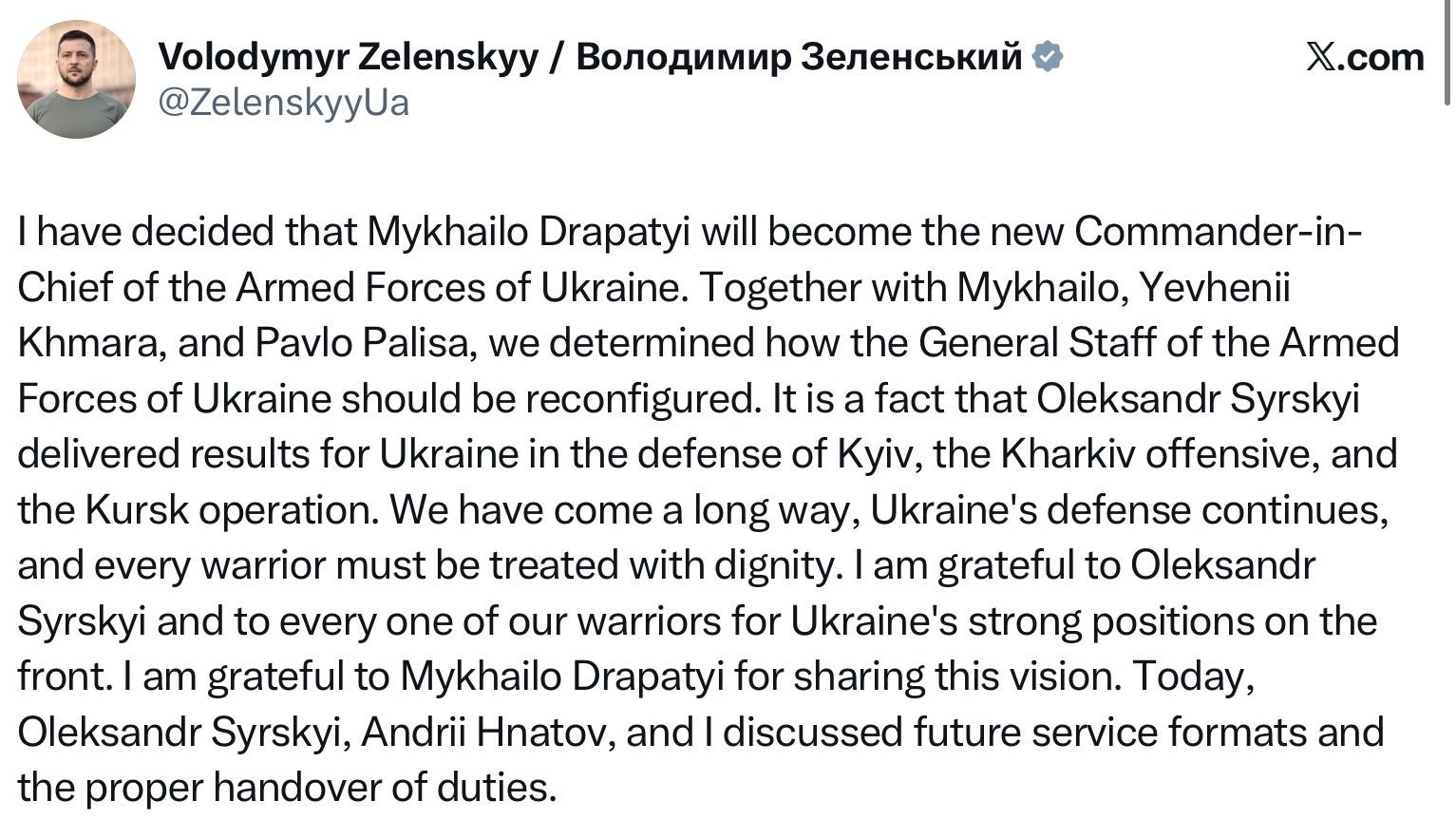
Paired with a reforming minister, Drapatyi’s leadership and reform instincts could finally bring the political and military spheres of Ukraine’s war effort into a fully unified state.
Three priorities will test the new team quickly.
The first is to sustain Ukraine’s current momentum. Ukrainian forces have clawed back ground around Kupiansk in the north-east and constrained Russian advances everywhere else. Ukraine’s mid- and long-range strike campaigns have separately hit Russian oil refineries, defence factories, air defence, operational logistics and shadow fleet. Occupied Crimea has been isolated by the Ukrainians and is increasingly difficult to sustain.
This pressure is imposing serious costs on Russia, and forcing it to choose between holding Crimea and defending the Russian homeland. The danger now is that a change of command creates a period of uncertainty while new leaders find their feet, and Russian forces exploit it. The new team’s first job is to make sure the reshuffle does not slow the tempo of operations at the front, deep inside Russia – or innovation inside the Ukrainian military.
You can read the full piece (for free) at the Lowy Interpreter site.
Congratulations on completing your PhD!
From the Lowry Institute:
“About the author
Mick Ryan is a Senior Fellow for Military Studies in the Lowy Institute’s International Security Program.”
That could now do with an update or two.
Great news from Zelenski! What appears to be a sound appointment. Maintenance of the momentum is indeed the task at hand. Pivoting the missile defense to hitting the archer and working on a solution for the arrow simultaneously, appears to be the only workable solution to the imbalance in strike v defense. IRS that leads to running the supply chain of components missiles and launchers will be critical given that interceptors may be a long way off even if PAC II builds can be jointly commenced with Germany!