
Ukraine's Long-Range Strike Command: Institutionalising Deep Strike
After years of technical and tactical innovation, as well collaboration between Ukrainian organisations and foreign agencies, Ukraine takes the next step in its long-range strike endeavours.

On 10 July 2026, Ukrainian President Zelenskyy signed a decree establishing a Long-Range Strike Command within Ukraine’s Armed Forces. In his address that evening, he described it as a command for long-range, effectively global, impact on Russia to concentrate 100 percent of available resources on degrading Russia’s warfighting potential. The reform brings together drone strike formations, missile forces, intelligence support from different agencies (and nations) as well as naval unmanned systems. Until now, these have operated largely in parallel, and at times competing with each other.
Ukraine’s long-range strike campaign has grown and accelerated in tempo over more than four years of operations and adaptation. It has built from a scattering of improvised drone attacks into perhaps the most significant military and psychological instrument Ukraine wields against Russia. Ukrainian strikes are shaping Moscow’s strategic calculus, support from the Trump administration and the views of Russian people, in ways that fighting along the front line in the Donbas has not fully managed to do. The new command is the Ukrainian government’s attempt to convert that into an enduring institutional capability. This occurs at a point in the war where Ukraine’s strike operations’ impact on Russia’s war economy and military posture has become substantial.
This article traces the journey that Ukraine has taken to reach this point, examines why the Ukrainian government chose now to formalise its long-range strike architecture, assesses what the new command can add to Ukraine’s strategic and political endeavours to end the war, and considers what Western militaries should learn from Ukraine’s example.
The Ukrainian Long-Range Strike Journey Since 2022
Ukraine’s long-range strike campaign has a clear lineage, one I have tracked across several articles here since the war’s early years. One of my earliest examinations was Striking Further, published in May 2023.
In May 2023, two small drones exploded above the Kremlin’s Senate Palace. Whatever its precise origin, the strike signalled that the war Putin had started in February 2022 could reach the seat of Russian power. Writing in Striking Further at the time, I described Ukraine’s drone strikes on Moscow as a demonstration of the country’s ever-lengthening reach, part of a pattern of wartime adaptation that Ukraine has pursued more successfully than almost any other dimension of its war effort.
By July 2023, strikes were reaching Moscow’s commercial and financial districts. Through 2024, the campaign broadened again, increasingly targeting the fuel depots, refineries and defence-industrial sites that sustain Russia’s war economy, as Ukraine’s Unmanned Systems Forces, established as its own branch in June 2024, matured into a sustained strike architecture.
The scale of attacks accelerated markedly from 2025. A March 2025 strike saw more than 70 drones intercepted near Moscow in a single day, the largest attack of the war to that point. By March 2026, Ukraine was sending roughly 250 drones toward the Moscow region over three consecutive days, and had launched approximately 7,000 long-range drones against Russian targets that month alone, overtaking Russia’s own long-range strike volume for the first time.
On 17 May 2026, Ukraine launched what Russian officials called the largest drone assault on the capital in more than a year, sending more than 500 unmanned systems into Russian territory and penetrating three of Moscow’s four air defence rings. President Zelenskyy described this campaign as Ukraine’s own “long-range sanctions” against Russia. Those signals were deliberate. Two days before the strike, Zelenskyy said he had met with the leadership of the General Staff, military intelligence and the Security Service of Ukraine to discuss expanding long-range strike operations, a meeting that brought together most of the institutions the new command would later be built to unify.
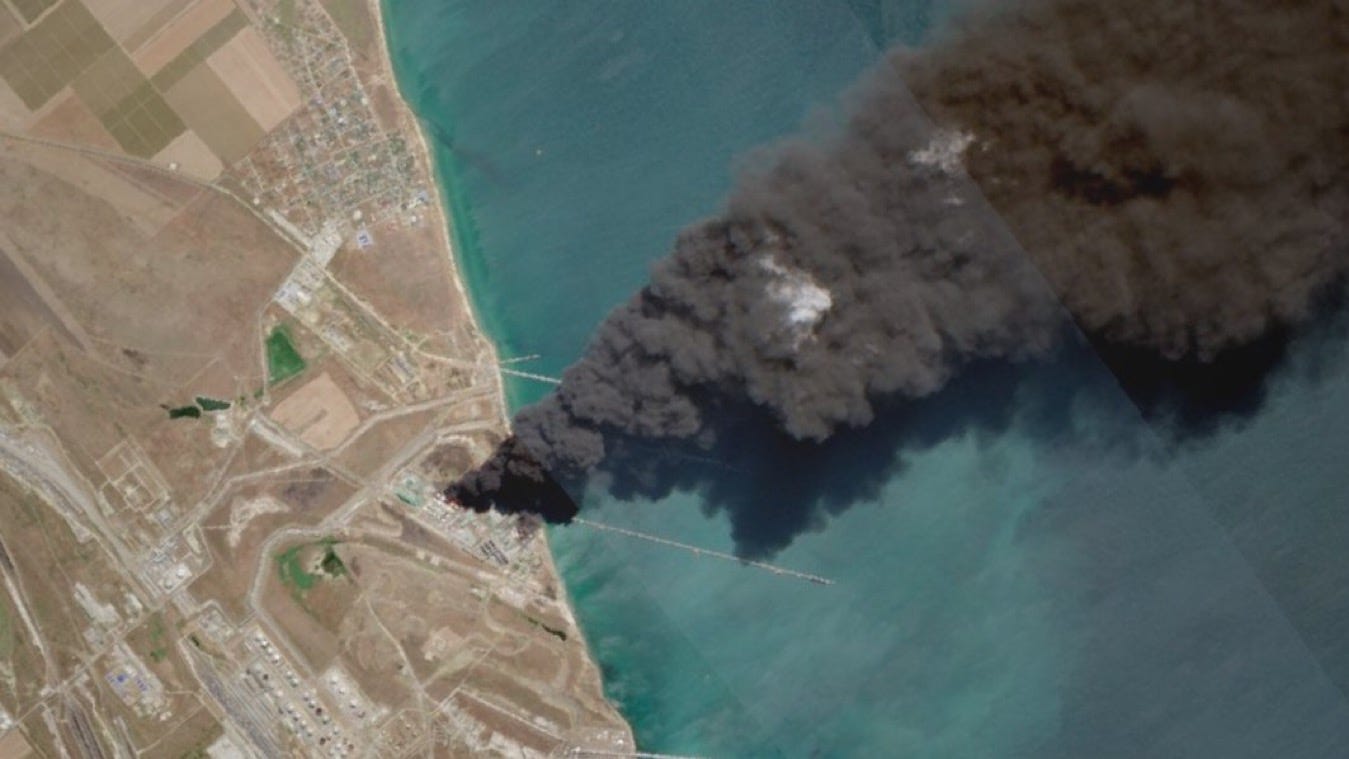
By mid-2026, the Ukrainian long-range strike campaign had become a continuous drumbeat of assaults on Russian targets. These attacks were routinely reaching targets more than 2,000 kilometres inside Russia. By July 2026, Ukrainian strikes were reaching the Ufa and Penza regions, more than 1,300 and 600 kilometres from the front respectively, hitting refineries and a components plant feeding Russia’s missile industry. Reuters reported that Russian domestic gasoline output had fallen to around 65 percent of capacity by the time the new command was announced. In the past week, Russian troops have begun to complain about fuel shortages on the frontline.
As I have chronicled previously, there are many elements that comprise a long range strike campaign. The five key components are:
1. Reconnaissance and surveillance systems.
2. Strike planning and monitoring processes.
3. The strike systems themselves, such as drones and missiles.
4. A robust deception and camouflage campaign to protect strike systems and ensure Ukraine is not telegraphing the next target and penetration routes.
5. Assessment, learning and adaptation systems for continuous improvement.
These have all seen ongoing enhancement as the long-range strike campaign has progressed. However, a separate element that has not kept pace with this growth was organisation. Long-range strikes were being planned and executed separately by drone units under the Unmanned Systems Forces, by missile forces, by the Security Service of Ukraine’s own strike architecture behind its 40-day campaign, and by naval unmanned systems units operating in the Black Sea and Sea of Azov. Each of these organisations developed its own targeting priorities and its own institutional interests.
The result, as I noted in my most recent Big Five edition, was a set of turf wars that at times slowed target prioritisation even as the campaign’s tempo and reach kept growing. The Long-Range Strike Command is Ukraine’s proposed solution to that structural problem – and for accelerating even more the hurt felt by Russia.
Ukraine’s Formation of the Long-Range Strike Command. Why Now?
Institutions tend to formalise a successful improvisation once the conservatives in military organisations can no longer obstruct evidence-based outcomes, and when new generations of leaders appreciate the need for future institutional reform to magnify gains already in evidence. This is a pattern that has repeated multiple times in history. During the First World War, the requirement for the most senior military leaders to better understand industrial production was followed by the establishment of the first war colleges. Around the same time, the introduction of aircraft was followed by the structural adaptation of new Air Forces.
Like previous instances of organisational innovation during and between wars, the strategic adaptation focussed on structural reforms follows an array of operational, technological and other changes in Ukraine’s war effort since 2022.
